APR vs Interest Rate: What Changes the Cost of a Loan?
Learn the difference between APR and interest rate, how fees affect the true cost of a loan, and what to compare before choosing between loan offers.
Published · Updated · By ToolNimbly
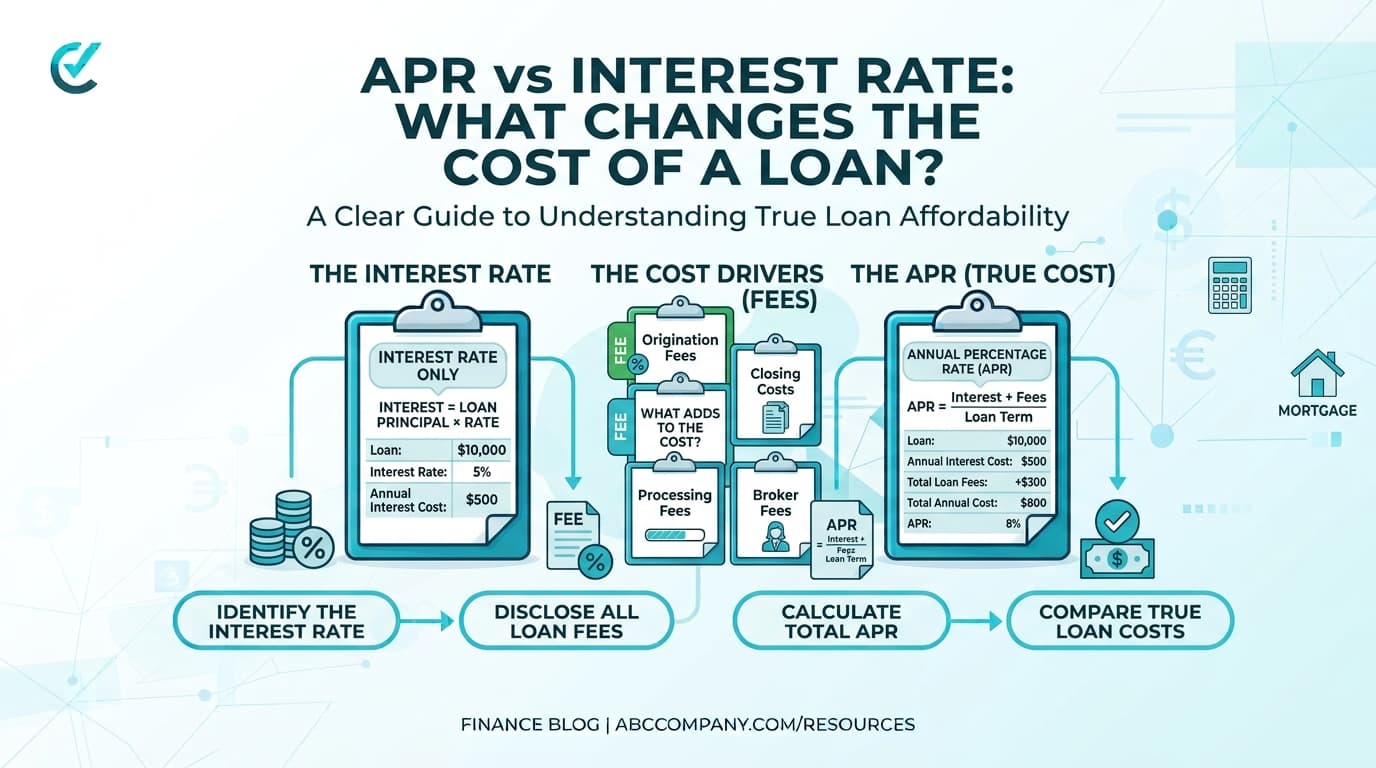
When comparing loans, you will often see two percentages listed side by side:
Interest rate: 8.5%
APR: 9.2%
At first glance, they may look like two ways of describing the same thing. They are not.
The interest rate tells you how much interest the lender charges on the amount you borrow.
The APR, or annual percentage rate, is designed to give you a broader measure of the cost of borrowing by incorporating the interest rate and certain additional loan charges.
That distinction matters because two loans can have the same interest rate but different borrowing costs.
A lender advertising a lower interest rate may charge higher origination fees or other finance charges. Another lender may offer a slightly higher interest rate but charge fewer upfront costs.
Understanding APR vs interest rate can help you compare those offers more carefully.
APR vs Interest Rate: Quick Comparison
Interest Rate | APR | |
|---|---|---|
What it measures | Cost of borrowing the principal | Broader annualized cost of credit |
Includes interest | Yes | Yes |
Includes certain fees | Usually no | Often yes |
Expressed as a percentage | Yes | Yes |
Used to calculate regular loan interest | Yes | Not usually |
Useful for comparing loan offers | Yes | Often more useful when comparing similar loans |
Can equal the other figure | Yes | Yes, if there are no additional included finance charges |
The Consumer Financial Protection Bureau describes a loan's interest rate as the cost paid to the lender for borrowing money. It describes APR as the interest rate plus additional fees charged with the loan.
The important word is broader.
APR can reveal borrowing costs that are not obvious from the interest rate alone.
What Is an Interest Rate?
An interest rate is the percentage a lender charges for allowing you to borrow money.
Suppose you borrow $20,000 at a 7% annual interest rate.
That 7% rate is one of the factors used to determine how much interest accrues on the outstanding loan balance.
For a typical amortizing installment loan, each scheduled payment includes two components:
Principal: the portion that reduces the amount you still owe.
Interest: the cost of borrowing the outstanding principal.
At the beginning of many amortizing loans, a larger portion of each payment goes toward interest because the outstanding balance is higher.
As you repay the principal, the interest portion generally falls and more of each payment goes toward reducing the remaining balance.
The CFPB describes amortization as the gradual repayment of a loan, with part of each payment going toward principal and part toward interest or finance charges.
Your interest rate is therefore extremely important, but it may not represent every cost required to obtain the loan.
What Is APR?
APR stands for Annual Percentage Rate.
APR attempts to express the cost of credit as an annual percentage while incorporating more than just the stated interest rate.
According to the Consumer Financial Protection Bureau, APR is a broader measure of borrowing cost because it reflects both the interest rate and certain fees associated with obtaining the loan.
Depending on the loan and applicable rules, those costs may include charges such as:
Origination charges
Certain lender fees
Points on some mortgage loans
Broker fees in some transactions
Other qualifying finance charges
Not every fee associated with obtaining, using or maintaining a financial product is necessarily included in every APR calculation.
Exactly which costs are included depends on the type of credit product, applicable regulations and how particular charges are classified.
That is one reason you should treat APR as a standardized comparison measure, not simply as:
Interest rate + every fee charged by the lender
The actual calculation is more structured than that.
A Simple Interest Rate Example
Suppose you borrow:
Loan amount: $10,000Interest rate: 8%Loan term: 3 years
If this is a standard fixed-rate amortizing loan with monthly payments, the lender calculates your payments using the loan balance, interest rate and repayment term.
At an 8% annual rate over 36 months, the monthly payment would be approximately:
$313.36 per month
Over 36 payments, you would pay approximately:
$11,281
That means roughly $1,281 of the total would represent interest in this simplified example.
These figures assume regular monthly payments, no missed payments, no extra repayments and no additional lender charges included in the payment calculation.
If the lender also charges an origination fee, the interest rate itself does not suddenly change.
But your cost of obtaining the loan does.
That is where APR becomes particularly useful.
How Fees Can Make Two Loans With the Same Interest Rate Cost Different Amounts
Imagine two lenders offer you the same basic loan:
Amount financed: $10,000Term: 3 yearsInterest rate: 8%
Lender A charges no origination fee.
Lender B charges a $500 origination fee.
If both loans use the same principal, repayment term and interest rate, their scheduled principal-and-interest payments could appear identical.
But the loans do not have the same overall borrowing cost.
With Lender B, you have an additional $500 charge associated with obtaining the loan.
If the fee is deducted from the loan proceeds, the difference becomes even easier to understand.
You might technically borrow $10,000 but receive only $9,500 after the $500 fee is withheld, while still being required to repay the loan according to the agreed $10,000 balance.
The headline interest rate alone does not communicate that difference.
APR is intended to capture certain additional credit costs so borrowers can make a more informed comparison.
Why Is APR Usually Higher Than the Interest Rate?
When a loan includes fees that must be incorporated into its APR, the APR will generally be higher than the stated interest rate.
For example:
Interest rate: 6.5%
might be accompanied by:
APR: 6.9%
The difference does not necessarily mean the lender is charging two separate interest rates.
The loan's interest calculations may still use the 6.5% contractual rate.
The 6.9% APR reflects a broader annualized measure of borrowing cost after applicable charges are considered.
For mortgages, the CFPB specifically explains that APR reflects the mortgage interest rate plus costs such as points, broker fees and certain other charges. As a result, mortgage APR is usually higher than the interest rate.
If a loan has no additional costs that must be incorporated into APR, the APR and interest rate may be the same or very close.
Does APR Determine Your Monthly Payment?
Not usually in the way people sometimes assume.
For a standard fixed-rate installment loan, your principal-and-interest payment is generally calculated using factors such as:
Principal balance
Contractual interest rate
Loan term
Payment frequency
APR is primarily a disclosure and comparison measure.
This distinction is important when using loan calculators.
If you enter:
$20,000 loan7% interest rate5-year term
a standard loan calculator will generally use the 7% rate to estimate your scheduled payment.
You should not replace the interest rate with the APR unless the calculator specifically tells you to do so.
Example: Same Interest Rate, Different Fees
Consider these hypothetical loans:
Loan A | Loan B | |
|---|---|---|
Loan amount | $20,000 | $20,000 |
Interest rate | 7% | 7% |
Term | 5 years | 5 years |
Origination fee | $0 | $1,000 |
Looking only at the interest rate would suggest the loans have identical borrowing costs.
They do not.
Loan B carries an additional $1,000 fee.
Depending on how that fee is handled, the borrower might pay it upfront, finance it as part of the loan, or have it deducted from the amount disbursed.
The APR disclosure can help reflect the impact of qualifying charges on the cost of credit.
This is why comparing only advertised interest rates can miss important information.
Example: Lower Interest Rate Does Not Always Mean Lower Overall Cost
Now imagine two hypothetical loan offers:
Loan A
Interest rate: 6.5%
Higher upfront fees
Loan B
Interest rate: 6.8%
Lower upfront fees
It might be tempting to immediately choose Loan A because 6.5% is lower than 6.8%.
But that comparison is incomplete.
If Loan A has significantly higher qualifying fees, its APR could be higher than Loan B's.
This does not automatically mean Loan B is the right loan for every borrower.
How long you keep the loan can also matter.
If one loan has higher upfront costs but a lower ongoing rate, the relative economics can change depending on whether the loan is held for its full term or repaid early.
APR gives you another useful number to compare, but it does not remove the need to understand the actual terms of the loan.
APR Is Most Useful When Comparing Similar Loans
APR is particularly useful when comparing loans with similar:
Loan amounts
Repayment periods
Rate structures
Payment schedules
Product types
The more different the loans become, the more careful you need to be.
For example, comparing the APR of a 3-year personal loan with the APR of a 7-year loan does not tell you the full story.
The longer loan may have a smaller monthly payment but require payments for much longer.
That could result in a higher total amount paid even if one of its percentage figures appears attractive.
Similarly, comparing a fixed-rate loan directly with a variable-rate loan can be difficult because the future rate on the variable loan may change.
The CFPB specifically warns borrowers to be careful when comparing APRs across fixed-rate and adjustable-rate mortgages because the products behave differently over time.
Why You Should Not Compare APR Alone
APR is useful, but it should not be the only number you examine.
When comparing loans, you may also want to look at:
Monthly payment
Can the scheduled payment fit within the borrower's budget?
Loan term
How long will payments continue?
Total payments
How much could be paid over the entire scheduled term?
Fees
Are there origination charges, closing costs or other costs?
Rate type
Is the interest rate fixed or can it change?
Prepayment terms
Can the balance be repaid early, and are there contractual charges or restrictions for doing so?
Loan amount actually received
If fees are deducted from the proceeds, how much money will actually reach the borrower?
APR helps organize some borrowing costs into a comparable percentage, but it cannot summarize every contractual feature of a loan.
Loan Term Can Change the Comparison
Suppose you are comparing a 3-year loan with a 5-year loan.
The 5-year loan may produce a lower monthly payment because the balance is spread across more payments.
That does not necessarily make it cheaper overall.
Take a $20,000 loan at the same hypothetical interest rate.
If you repay it over three years, each monthly payment is higher, but interest has less time to accumulate.
If you repay it over five years, the monthly payment falls, but you remain in debt longer.
This is why a loan comparison should consider both:
What does this cost each month?
and
What could I pay over the entire repayment schedule?
You can compare payments and an amortization schedule to see how changing the loan amount, interest rate or term affects scheduled payments.
What Is an Amortization Schedule?
An amortization schedule shows how each scheduled loan payment is divided between principal and interest.
For each payment, it can show:
Starting loan balance
Payment amount
Interest portion
Principal portion
Remaining balance
This can make the effect of an interest rate much easier to understand.
Suppose your monthly payment is $500.
At the beginning of the loan, perhaps $150 goes toward interest and $350 reduces principal.
Later, as the outstanding balance becomes smaller, perhaps only $50 goes toward interest and $450 reduces principal.
The exact amounts depend on the loan.
An amortization schedule lets you see that progression instead of looking only at the monthly payment.
What Assumptions Does Our Loan Calculator Make?
It is important to understand what a calculator is actually calculating.
Our loan calculator uses the interest rate you enter when estimating loan payments and producing the amortization schedule.
It does not independently calculate a lender-specific APR from origination fees, points, closing charges or other lender-specific costs.
That distinction matters.
If a lender tells you:
Interest rate: 7%APR: 7.6%
and you enter 7% into the calculator, the calculator models the loan using the entered 7% interest rate.
It is not claiming that 7% is the APR.
For the examples in this guide, the calculations assume a standard fixed-rate amortizing loan with regular monthly payments, no missed payments and no additional payments unless otherwise specified.
Actual lender calculations may differ because of:
Fees
Payment dates
Day-count conventions
Compounding methods
Rate adjustments
Insurance
Taxes
Optional products
Prepayments
Late payments
Other contractual terms
For an official APR, use the APR disclosed by the lender or calculate it using all of the required transaction-specific information and the rules that apply to that loan.
Can You Calculate APR From the Interest Rate Alone?
No.
Knowing that a loan has an 8% interest rate is not enough to determine its APR if additional qualifying fees are involved.
You may also need information such as:
Loan amount
Loan term
Payment schedule
Finance charges
Origination fees
Points
Timing of fees
Amount actually financed
The CFPB's lending regulations illustrate why APR calculations can become more complex when transaction charges, loan fees and other finance charges are involved.
For this reason, simply adding a fee percentage to an interest rate is not a reliable way to calculate APR.
For example, an 8% interest rate plus a 2% origination fee does not automatically mean a 10% APR.
The timing of the fee, term of the loan and amount financed all matter.
Is a Lower APR Always a Better Loan?
A lower APR generally indicates a lower annualized cost of credit when comparing similar loans under the assumptions used to calculate the APR.
But it does not automatically make one loan preferable in every situation.
Imagine Loan A has a lower APR but requires repayment within three years.
Loan B has a higher APR but allows repayment over six years.
Loan A might cost less overall but require a much larger monthly payment.
Loan B might provide a lower monthly payment but cost more over time.
Which structure fits a borrower's circumstances depends on factors that APR alone cannot answer.
There may also be meaningful differences in:
Fixed versus variable rates
Early repayment terms
Collateral requirements
Payment flexibility
Fees not reflected in the headline comparison
Loan term
Required insurance or related products
APR should therefore be treated as one important comparison tool, not as a complete description of a loan.
APR vs Interest Rate on a Mortgage
Mortgages are one of the most common places borrowers see both figures.
The interest rate tells you the rate applied to the mortgage balance.
APR incorporates the interest rate plus certain costs associated with obtaining the mortgage.
The CFPB lists mortgage costs such as points, broker fees and certain other charges as factors that can be reflected in APR.
This means two mortgage offers with identical interest rates may have different APRs because their fees differ.
However, borrowers should still review the complete loan terms rather than choosing based on APR alone, especially when comparing adjustable-rate and fixed-rate mortgages.
APR vs Interest Rate on an Auto Loan
The same basic distinction applies to vehicle financing.
The interest rate is the rate charged for borrowing.
APR reflects a broader cost of credit that can include qualifying lender fees.
For U.S. auto lending specifically, the CFPB explains that the Truth in Lending Act requires certain disclosures before a borrower becomes obligated on the loan, including APR and other important costs.
Disclosure requirements differ between jurisdictions, so borrowers outside the United States should check the rules that apply where they live.
The underlying lesson is universal: do not assume that the advertised interest rate represents every cost associated with borrowing.
Frequently Asked Questions About APR and Interest Rates
What is the difference between APR and interest rate?
The interest rate represents the cost charged for borrowing the principal.
APR is a broader annualized measure that incorporates the interest rate and certain additional borrowing costs.
Why is my APR higher than my interest rate?
A higher APR can result when qualifying fees or finance charges are included in the cost calculation.
The interest rate may be used to calculate your scheduled loan interest, while APR reflects a broader measure of the cost of obtaining credit.
Can APR and interest rate be the same?
Yes.
If there are no additional charges that cause the APR to differ, the two figures may be identical or very close.
Does a loan calculator use APR or interest rate?
Our loan calculator uses the interest rate entered into the calculator to estimate scheduled payments and generate an amortization schedule.
It does not independently calculate a lender-specific APR from fees and other lender charges.
Does APR include every loan fee?
Not necessarily.
Which charges are incorporated into an APR depends on the type of credit, applicable regulations and how individual charges are treated.
Always review the lender's disclosures and fee schedule rather than assuming APR contains every possible expense.
Should I compare loans using APR?
APR can be helpful when comparing similar loan products because it incorporates more borrowing costs than the interest rate alone.
However, also compare the loan term, monthly payment, total repayment, rate type, fees and other contractual conditions.
Is a lower interest rate always cheaper?
Not necessarily.
A loan with a lower stated interest rate could include higher fees. Loan term also matters because borrowing for longer can increase the total amount of interest paid.
Does APR tell me my monthly payment?
Not by itself.
Monthly payments generally depend on the amount borrowed, contractual interest rate, repayment term, payment frequency and structure of the loan.
The Bottom Line
The difference between APR and interest rate comes down to what each number measures.
The interest rate tells you the rate charged for borrowing the principal.
APR provides a broader annualized measure of borrowing cost by incorporating the interest rate and certain additional finance charges.
That means two loans with the same interest rate can still have different APRs and different overall costs.
But APR is not the only figure worth comparing.
Look at the monthly payment, repayment period, total scheduled payments, fees, rate structure and other loan conditions.
If you want to see how the amount borrowed, interest rate and repayment period affect your scheduled payments, you can compare payments and an amortization schedule with our loan calculator.
Just remember that the calculator uses the interest rate you enter. It does not independently determine the lender's APR or incorporate lender-specific fees unless those capabilities are explicitly provided.
For an actual loan offer, use the lender's official disclosures when evaluating its stated APR, fees and contractual terms.
Put this into practice
Use the Loan tool for the calculation, then read How extra loan payments save interest for the supporting explanation.