Cleaning Invoice Template: Examples for House Cleaners
Learn how to create a professional cleaning invoice. Get expert tips, essential elements, and examples for residential and commercial cleaning services.
Published · Updated · By ToolNimbly
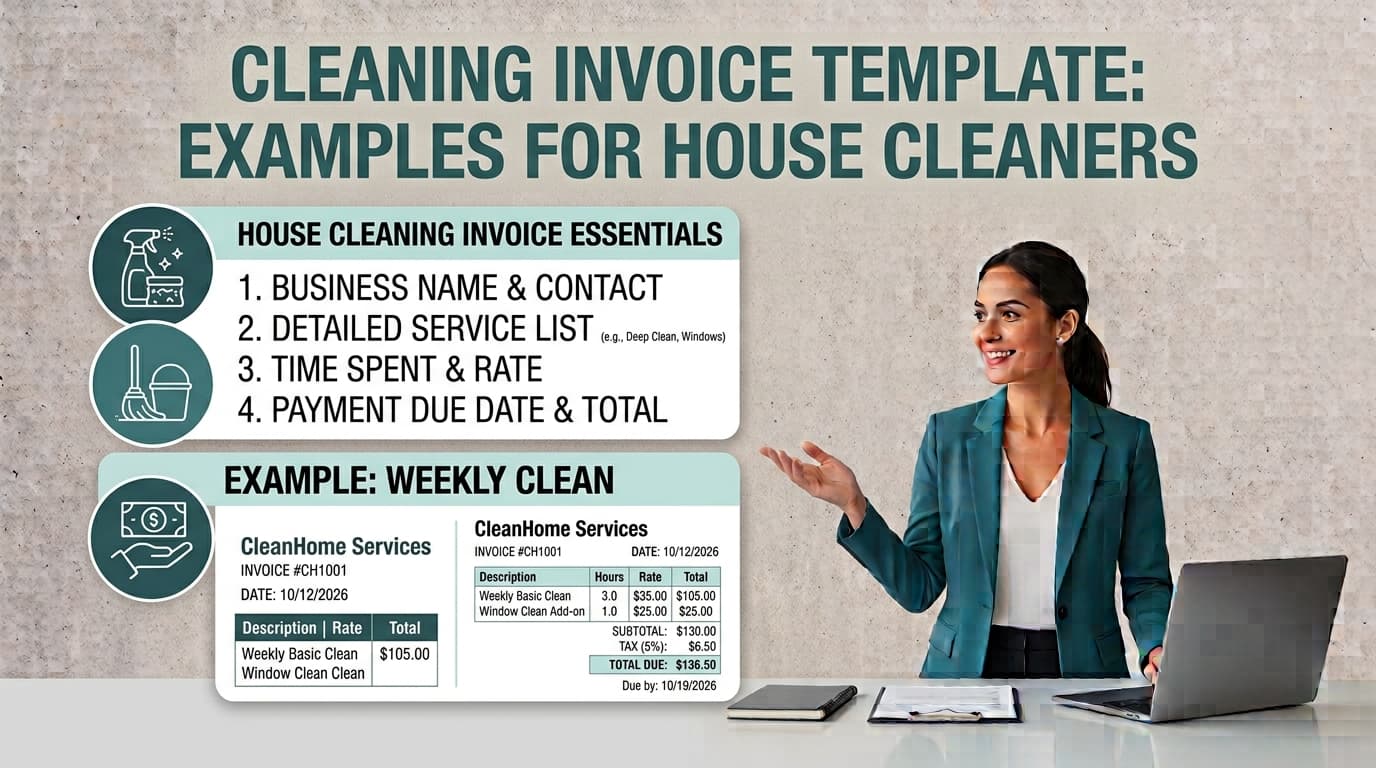
Running a successful cleaning business involves more than providing high-quality service. It requires a professional administrative process that helps you track your work and manage your billing. A well-structured cleaning invoice serves as a clear communication tool between you and your client, outlining the services provided and the amount due.
Many cleaning business owners find that consistent billing practices help them stay organized. By adopting a clear format, you provide your clients with a professional document that makes it easy for them to understand their charges and process payments.
Why a Professional Cleaning Invoice Matters
An invoice acts as a formal request for payment. It provides a record of the transaction, detailing the specific services performed, the date of the work, and the total amount owed. For your own business records, maintaining copies of these documents is a practical way to track your income and organize your financial history.
Unlike a receipt, which confirms that a payment has already been received, an invoice is sent to initiate the payment process. When you provide a clear, itemized document, you reduce the likelihood of client confusion. This clarity can help facilitate smoother interactions regarding your charges.
Essential Elements of a Cleaning Service Invoice
To create an effective document, consider including the following components:
Header Information: Include your business name, address, phone number, and email. It is also helpful to include the client’s name and the address where the cleaning service was performed.
Unique Identifiers: Using a unique invoice number for each document is a practical way to keep your records organized and makes it easier to reference specific jobs later.
Dates: Clearly state the date the invoice was issued and the date by which you expect payment.
Itemized Services: Instead of using vague descriptions, list each service performed. Examples include "Deep Cleaning," "Window Washing," or "Supply Fee."
Financials: Show the unit price (such as an hourly rate or a flat fee), the subtotal, any applicable tax, and the final total amount due.
Payment Terms: Clearly state your accepted payment methods, such as bank transfer or check, and the timeline for payment.
If you are looking for a way to format these details, you can make a cleaning invoice using an online generator to organize your information into a professional PDF.
Cleaning Invoice Examples: Residential vs. Commercial
The structure of your invoice may change depending on the type of client you serve. Residential and commercial clients often have different expectations regarding the level of detail and the frequency of billing.
Residential Cleaning Invoice Example
Residential clients often prefer simple, clear billing. If you provide recurring services, your invoice should highlight the frequency of the visit to help the client identify the specific service period.
Service: Bi-weekly Standard Cleaning
Date of Service: October 12, 2023
Line Items:
Standard House Cleaning (3 bedrooms, 2 baths): $180.00
Add-on: Interior Oven Cleaning: $40.00
Add-on: Baseboard Detail: $25.00
Subtotal: $245.00
Tax: $15.00
Total Due: $260.00
Payment Terms: Due upon receipt.
Commercial Cleaning Invoice Example
Commercial or janitorial invoices often require more formal terms and a detailed breakdown of the facility areas to align with the scope of work.
Service: Monthly Janitorial Services
Site Location: Office Suite 200, 123 Business Park
Line Items:
Daily Restroom Sanitation (20 visits): $600.00
Floor Buffing and Waxing (Common Areas): $350.00
Trash Removal and Recycling: $150.00
Subtotal: $1,100.00
Total Due: $1,100.00
Payment Terms: Net 30.
Best Practices for Managing Your Billing Cycle
Improving your administrative workflow starts with how you handle your billing cycle. Sending an invoice shortly after the work is completed keeps the service fresh in the client's mind. For residential clients, providing clear instructions on how to pay can remove friction from the process.
Set clear expectations regarding payment policies from the start of your relationship. If you have specific policies regarding payment timelines, ensure these are communicated clearly to your clients. Consistency in your billing process is a useful tool for keeping your accounts organized.
Common Invoicing Practices to Consider
Administrative errors can lead to confusion or delays. Consider these practices to keep your business records accurate:
Specific Descriptions: Always be specific. If a client sees a vague description, they may reach out for clarification, which can delay the payment process.
Consistent Numbering: Using a logical, sequential system for your invoice numbers makes it easier to track your records over time.
Clear Documentation: Remember that an invoice is a request for payment. It is helpful to have a clear understanding of the scope of work before you begin a job, which is often handled through a separate service agreement.
Scaling Your Administrative Workflow
As your cleaning business grows, manual invoicing can become time-consuming. Transitioning to digital templates allows you to store client information and create documents more efficiently. By using digital tools, you can ensure that your branding remains consistent across every document you send.
This level of polish helps build trust with your clients. When you provide a clean, professional-looking invoice, you demonstrate that you value organization and reliability. This is particularly important for high-value clients who expect a professional experience from start to finish.
Managing Client Expectations and Communication
Communication is a key part of effective billing. If a client has questions about a charge, they should feel comfortable reaching out to you. Include your contact information prominently on every invoice. If you notice a pattern of questions regarding specific line items, consider refining your service descriptions to be more descriptive.
Furthermore, proactive communication regarding upcoming payments can be helpful. For commercial clients, a friendly reminder a few days before a payment is due can be a useful touch. This professional approach reinforces your commitment to the partnership and helps maintain a healthy business relationship.
Frequently Asked Questions
Is an invoice a contract?
An invoice is a request for payment and a record of a transaction. It is not a contract. A service agreement should be used to define the scope of work and the expectations of both parties before the work begins.
Do I need to charge tax on my cleaning services?
Tax requirements vary significantly by state and locality in the United States. There is no national standard. You should check your specific state and local government websites to determine if cleaning services are taxable in your jurisdiction.
Should I include late fees on my invoices?
You may include late fees if they were clearly established in your initial terms of service. Communicating these policies upfront helps prevent misunderstandings when a payment becomes overdue.
How can I make my invoices look more professional?
Use a consistent template that includes your company logo, clear typography, and a clean layout. Ensure that the math is accurate and that the document is saved as a PDF to maintain its formatting.
What should I do if a client has not paid?
First, verify that the service was performed and the invoice was received. Send a polite follow-up inquiry. If the issue persists, refer to your initial service agreement to understand your options for resolving the matter.
How does the invoice generator work?
The invoice generator allows you to create a conventional invoice that can be printed or downloaded as a PDF. You can add your business and client details, an invoice number, issue and due dates, currency, line items, payment instructions, terms, notes, discounts, tax, and fees. The tool calculates line totals, subtotals, and the final balance due using decimal arithmetic. You can add a logo, which is processed locally and is not uploaded to a server. The tool requires no signup and does not store your data on a server; any drafts are stored only in your current browser.
Disclaimer: This information is for educational purposes and does not constitute legal, tax, or accounting advice. Regulations vary by location, so consult with a qualified professional regarding your specific business needs.
Put this into practice
Use the Invoice tool for the calculation, then read What an invoice needs to contain for the supporting explanation.