Construction Invoice Template: Guide and Sample
Struggling with payment delays? Learn how to create a professional construction invoice sample with our guide on progress billing, retainage, and essential line items.
Published · Updated · By ToolNimbly
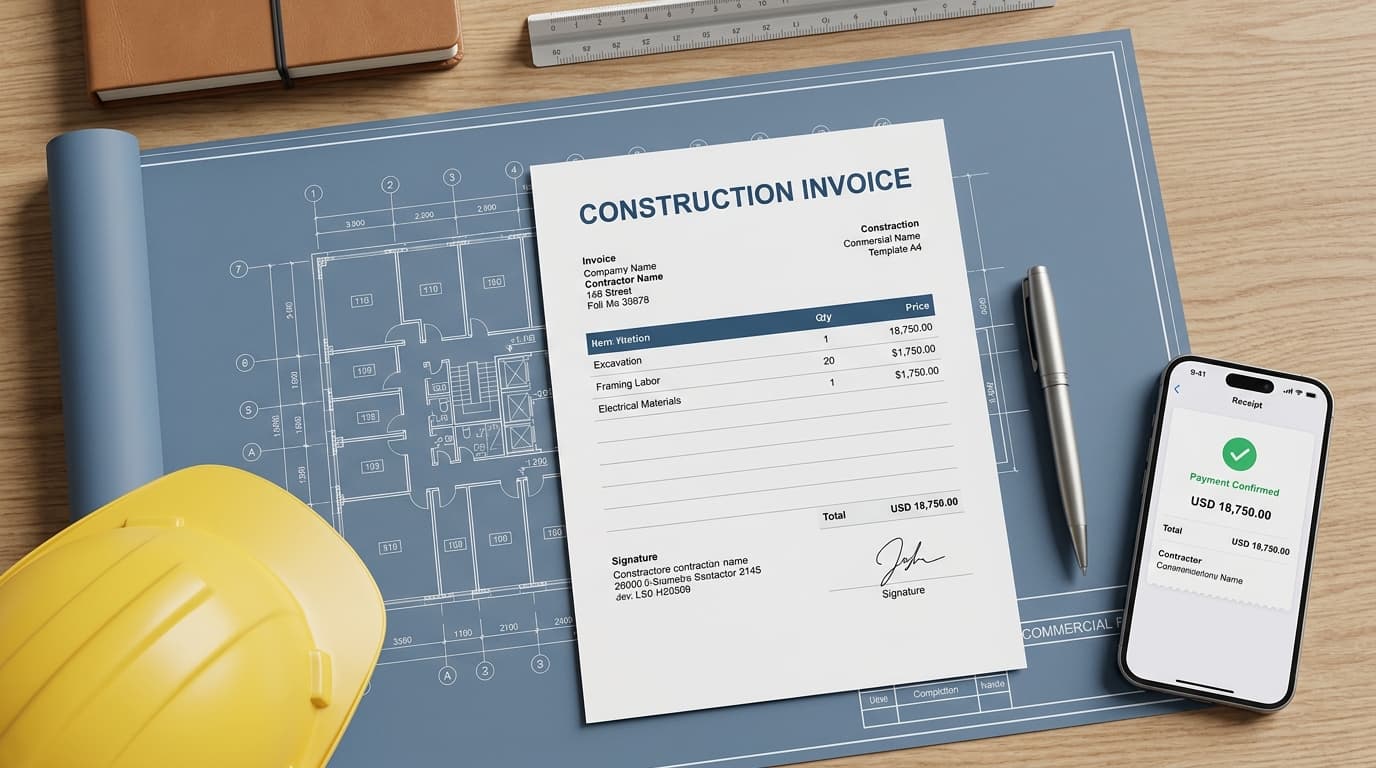
Construction projects involve complex workflows, multiple stakeholders, and extended timelines. Unlike retail transactions where a product is exchanged for immediate payment, construction billing is project-based. When your billing process lacks clarity or fails to align with the project scope, you may encounter administrative friction. A professional construction invoice serves as a clear, itemized request for payment that helps client accounting departments verify work progress against the original agreement.
The Anatomy of a Professional Construction Invoice
Standard service invoices often fail in construction because they lack the context required to verify work progress. To ensure your invoice is processed efficiently, it should function as a formal record of the work performed during a specific billing period.
An effective invoice for a construction company often includes these fields:
Project Identification: Clearly state the project name and the physical address where the work was performed. Larger firms often manage multiple jobs simultaneously; including this information helps ensure the invoice is directed to the correct project file.
Unique Invoice Number: Use a consistent numbering system to help both you and your client track requests.
Contract Reference: Include the original contract number or purchase order identifier. This allows the client to link your request to the approved budget.
Billing Period: Define the exact dates covered by the invoice. This is useful for progress billing, as it helps prevent overlap or gaps in your claim.
Itemized Labor and Materials: Break down costs by task, such as "Installation of 400 sq. ft. drywall" or "Electrical rough-in - Phase 2."
When you are ready to prepare your documents, you can create a construction invoice to format, preview, print, or download an invoice as a PDF. This tool allows you to input your specific business details, add line items for labor and materials, and perform calculations for subtotals, taxes, and balance due. Reviewing a high-quality construction invoice sample can help you understand how to structure these fields to ensure your documentation aligns with your project requirements.
Mastering Progress Billing and Retainage
Construction projects are often paid out in stages. Understanding how to present these stages is a practical way to maintain a steady workflow.
Progress Billing
Progress billing involves invoicing for the percentage of work completed during a specific timeframe. This is common in commercial and large-scale residential projects. To bill effectively, you might track your progress against a Schedule of Values, a document that breaks down the total contract price into individual line items. By billing against these specific values, you provide the client with a clear, verifiable metric for payment.
Managing Retainage
Retainage is a practice where an owner or general contractor withholds a portion of each payment until the project reaches substantial completion or specific milestones.
You can display retainage on your invoice to maintain transparency. For example, if you have a $50,000 progress claim with a 10% retainage, your invoice could show the gross amount ($50,000), the retainage deduction ($5,000), and the net payment due ($45,000). Always check your contract to confirm the specific retainage percentage and the conditions for its release, as these terms vary by project.
Handling Change Orders and Documentation
Payment delays often occur when an invoice includes undocumented work. Even if you have performed extra tasks, you should maintain a formal paper trail to support your request.
The Change Order Workflow
Before you invoice for additional work, ensure you have a signed change order. List these as separate line items on your invoice so they are easily distinguishable from the original contract scope. Vague additions can trigger internal reviews that may slow down the processing of your invoice.
The Importance of Backup
Clients often require backup documentation to approve an invoice for construction work. Depending on your contract, this may include material receipts, invoices from suppliers, or daily logs and timesheets for labor. When you provide this documentation, you reduce the back-and-forth between you and the client accounting team. Keep your line items concise but descriptive, ensuring that every dollar requested is tied to a specific, authorized activity.
Best Practices for Consistent Billing
Consistency is a practical way to improve your collection speed. When your client receives an invoice that follows a predictable format, their accounting department can process it with minimal effort.
Standardize Your Format: Stick to one layout for all your billing. A consistent look builds professional recognition and makes it easier for clients to locate key information.
Align with the Schedule of Values: Your invoice should mirror the line items in your original contract. If the client accounting software is set up to track specific categories, your invoice should match those categories.
Define Payment Terms: Clearly state your payment terms, such as Net 30, on the invoice. While the contract governs the legal timeline, a clear reminder on the document itself serves as an effective reference.
Follow Up: If payment is delayed, reach out promptly. Often, a payment is held up simply because a piece of documentation was missing or the invoice did not match the purchase order.
Organizing Your Billing Workflow
Beyond the invoice document itself, your internal organization plays a significant role in how quickly you get paid. Consider these steps to streamline your process:
Centralize Project Records: Keep a dedicated folder for every project containing the signed contract, all approved change orders, and copies of previous invoices.
Verify Before Sending: Before finalizing an invoice, compare the current request against the total contract value. Ensure that the sum of all invoices to date does not exceed the agreed-upon budget unless a change order has been processed.
Use Clear Descriptions: Use the same terminology for tasks that appears in your contract. If the contract refers to "Rough Carpentry," do not change the line item on your invoice to "Wood Framing."
Maintain a Log: Keep a simple spreadsheet or log of all invoices sent, the date they were sent, the amount, and the status of payment. This helps you identify which invoices are approaching their due date.
Frequently Asked Questions
Why is my construction payment being delayed?Payment delays are often caused by missing documentation or a mismatch between the invoice line items and the original contract. If your invoice does not clearly link to the work described in the contract, it may be flagged for verification.
How should I handle retainage in my records?Retainage is typically treated as a separate receivable because these funds are held by the client until project completion or a specific milestone. Tracking them separately ensures your financial records accurately reflect what you are owed versus what is currently collectible.
What is the best way to format an invoice?Use a consistent template that includes your business information, the client's information, a unique invoice number, clear itemized descriptions of the work performed, and explicit payment terms.
Does the invoice act as a legal document?An invoice is a request for payment and a business record. Its effect depends on the underlying contract and the specific jurisdiction in which the work was performed. It is not a substitute for a signed contract.
Disclaimer: This guide is for educational purposes and does not constitute legal, tax, or accounting advice. Construction laws and payment cycles vary significantly by jurisdiction. Always consult with legal counsel or a qualified professional regarding your specific contracts and regional requirements.
Put this into practice
Use the Invoice tool for the calculation, then read What a payment receipt should include for the supporting explanation.