How Many Work Hours Are in a Year? 2,080 and Other Schedules
Learn why 2,080 hours is commonly used for a 40-hour work year, how other schedules change the total, and how to convert salary to hourly pay accurately.
Published · Updated · By ToolNimbly
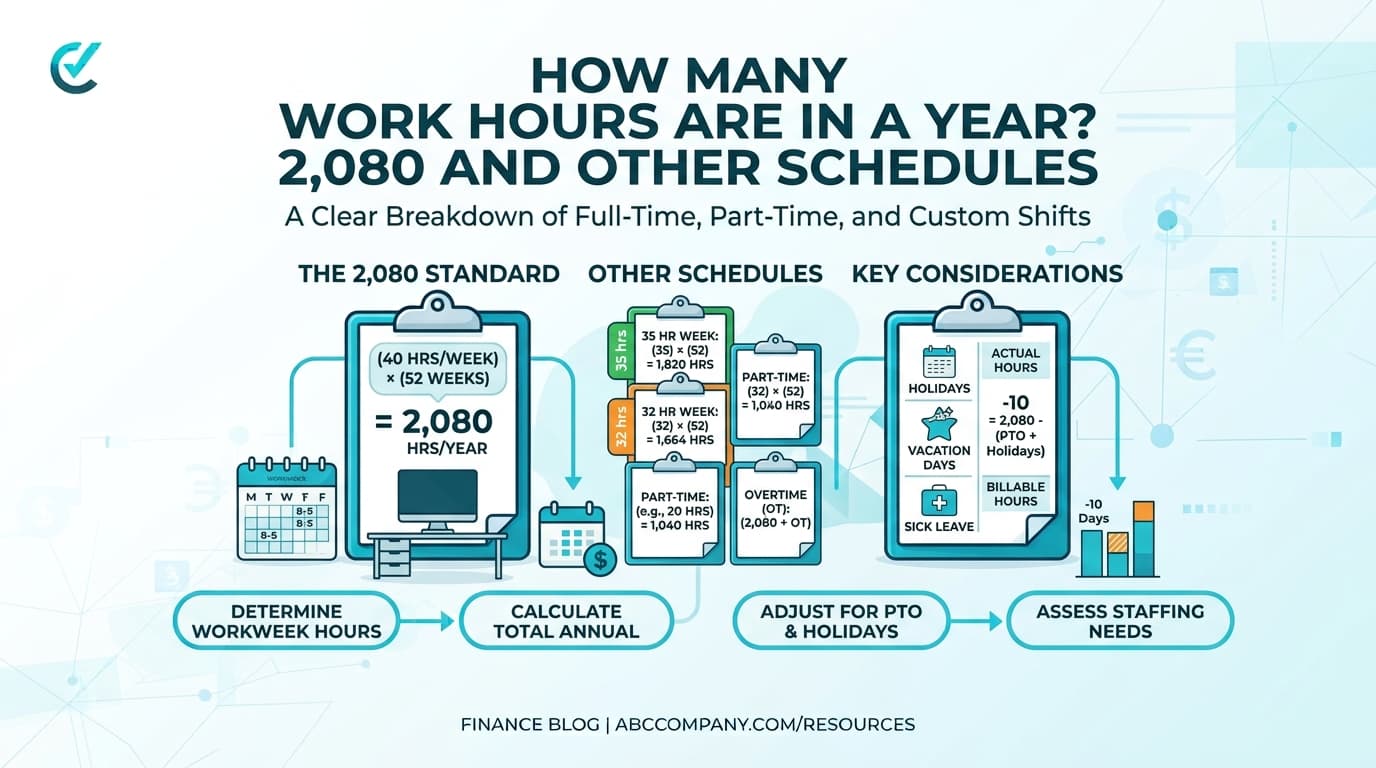
If you work 40 hours a week, you will often see 2,080 hours used as the number of work hours in a year.
The calculation is simple:
40 hours per week × 52 weeks = 2,080 hours per year
That number is commonly used when converting an annual salary into an hourly rate.
For example, someone earning $52,000 per year on a 40-hour schedule has a basic hourly equivalent of:
$52,000 ÷ 2,080 = $25 per hour
But 2,080 is not the correct number for every worker.
Your actual annual work hours can change because of your weekly schedule, part-time work, unpaid leave, paid time off, holidays, overtime and even the specific way an employer defines working time.
This guide explains where the 2,080-hour figure comes from, how many hours different schedules produce, and how to use annual hours when converting between salary and hourly pay.
Why Are There 2,080 Work Hours in a Year?
The familiar 2,080 work hours per year figure comes from multiplying a standard 40-hour workweek by 52 weeks:
40 × 52 = 2,080
You can break that down further.
A person working five eight-hour days each week works:
8 hours × 5 days = 40 hours per week
Over 52 weeks:
40 hours × 52 weeks = 2,080 hours
This is why salary calculators commonly use 2,080 as the default annual hours for someone working a traditional 40-hour schedule.
It is a useful convention, but it should not be mistaken for a legal definition of full-time employment.
For example, in the United States, the Department of Labor states that the Fair Labor Standards Act does not define full-time or part-time employment. Those classifications are generally determined by the employer.
The U.S. Bureau of Labor Statistics, meanwhile, classifies people who usually work at least 35 hours per week as full-time workers for certain statistical purposes. It specifically notes that this is a statistical definition, not a legal one.
So while 40 hours is a common full-time schedule, "full time" does not always mean exactly 40 hours.
Are There Exactly 2,080 Working Hours in Every Calendar Year?
Not necessarily.
The 2,080 calculation assumes exactly 52 workweeks:
52 × 40 = 2,080
But 52 weeks contain only 364 days.
A normal calendar year has 365 days, while a leap year has 366. As a result, the number of weekdays in an actual calendar year varies depending on where weekends fall.
This distinction is important if you are calculating precise payroll hours rather than simply converting an annual salary into an approximate hourly rate.
The U.S. Office of Personnel Management provides a useful example. It explains that 2,080 was historically used for certain federal pay calculations because it represents 52 weeks of 40 hours. However, because calendar years contain more than exactly 52 weeks, most U.S. federal civilian employees now use a statutory divisor of 2,087 hours when converting annual basic pay into an hourly rate.
That does not mean everyone should replace 2,080 with 2,087.
It shows why 2,080 should be understood for what it is: a convenient annualization of a 40-hour weekly schedule.
How Many Hours Are in a Full-Time Work Year?
If your schedule is 40 hours per week for 52 weeks, the answer is:
2,080 hours per year
For other weekly schedules, the number changes.
Weekly schedule | Annual hours using 52 weeks |
|---|---|
40 hours | 2,080 hours |
37.5 hours | 1,950 hours |
35 hours | 1,820 hours |
32 hours | 1,664 hours |
30 hours | 1,560 hours |
25 hours | 1,300 hours |
20 hours | 1,040 hours |
15 hours | 780 hours |
The calculation is always:
Weekly hours × 52 = annual scheduled hours
For someone working 35 hours per week:
35 × 52 = 1,820 hours
For someone working 30 hours:
30 × 52 = 1,560 hours
This is why using 2,080 automatically for every salary conversion can produce misleading results.
How to Convert Annual Salary to Hourly Pay
A basic salary-to-hourly conversion uses this formula:
Hourly pay = Annual salary ÷ Annual work hours
Suppose your annual salary is $62,400 and you work 40 hours per week.
Your annual hours are:
40 × 52 = 2,080
Then:
$62,400 ÷ 2,080 = $30 per hour
So the salary has an hourly equivalent of approximately $30 per hour.
If you want to calculate this using your own weekly hours instead of assuming 40 hours, you can convert salary to hourly pay using your actual schedule.
Unless stated otherwise, salary calculator results should be understood as gross pay before income tax, payroll tax, pension or retirement contributions, insurance, benefits and other deductions.
Your gross hourly equivalent is not necessarily the amount you actually take home.
Example: $52,000 Salary at 40 Hours Per Week
Consider an employee earning $52,000 per year.
If they work 40 hours per week:
40 × 52 = 2,080 annual hours
Then:
$52,000 ÷ 2,080 = $25
Their gross hourly equivalent is $25 per hour.
That does not mean $25 will appear in their bank account for every hour worked.
Taxes and other deductions may reduce take-home pay.
It is simply a conversion of gross annual salary into a gross hourly equivalent.
Example: $75,000 Salary at 37.5 Hours Per Week
Now consider someone earning $75,000 per year who works 37.5 hours each week.
Using 2,080 would not accurately reflect their normal schedule.
Their annual scheduled hours are:
37.5 × 52 = 1,950 hours
Their hourly equivalent is:
$75,000 ÷ 1,950 = approximately $38.46 per hour
If you had divided the same salary by 2,080 instead, you would have calculated approximately $36.06 per hour.
That difference shows why your actual weekly schedule matters when comparing salaries with hourly jobs.
What Happens to Annual Work Hours When You Take Paid Time Off?
Paid time off creates an important distinction between paid scheduled hours and hours actually worked.
Suppose you have a $52,000 salary, a 40-hour weekly schedule and two weeks of paid vacation.
Your normal annual schedule is still:
40 × 52 = 2,080 hours
If those two vacation weeks are paid as part of your regular salary, you may still use 2,080 when converting the annual salary into a conventional hourly equivalent.
That produces:
$52,000 ÷ 2,080 = $25 per hour
But you did not physically work all 2,080 hours.
Two weeks of vacation equal:
40 × 2 = 80 hours
So your hours actually worked would be approximately:
2,080 - 80 = 2,000 hours
If you divided your salary by only the hours actually worked:
$52,000 ÷ 2,000 = $26 per hour actually worked
These two figures answer different questions.
$25 per hour is the basic hourly equivalent of the annual salary using the employee's scheduled paid year.
$26 represents salary divided by the hours physically worked after excluding the paid vacation in this simplified example.
Neither calculation is automatically "more correct." You need to know what you are trying to measure.
Should You Subtract Paid Vacation From 2,080 Hours?
Not necessarily.
If you are simply converting a fixed annual salary into a standard hourly equivalent, paid vacation generally does not need to be removed from the annual schedule.
The employee is still being paid during that time.
If your goal is instead to estimate the number of hours you actually spend working during the year, then it makes sense to subtract paid days when you are not working.
For example, imagine someone works a 40-hour schedule and receives 15 paid vacation days.
Assuming eight hours per day:
15 × 8 = 120 hours of paid vacation
Their estimated actual working time becomes:
2,080 - 120 = 1,960 hours
That figure could be reduced further if you also wanted to exclude paid public holidays or other paid absences.
The important thing is to label the number correctly.
2,080 scheduled paid hours and 1,960 hours physically worked are describing different things.
What About Paid Holidays?
Paid holidays work similarly to paid vacation.
Suppose an employee works 40 hours per week and receives 10 paid holidays during the year.
Ten eight-hour days equal:
10 × 8 = 80 hours
If you are calculating hours physically spent working:
2,080 - 80 = 2,000 hours
If the employee also takes 15 paid vacation days:
15 × 8 = 120 hours
Then:
2,080 - 80 - 120 = 1,880 hours actually worked
Again, the employee may still receive their full annual salary.
That is why removing PTO from the denominator can be useful for calculating an effective amount earned per hour actually worked, but it is different from a standard salary-to-hourly conversion.
How Does Unpaid Leave Affect Annual Work Hours?
Unpaid leave is different because the employee is not being paid for that period.
Suppose an hourly employee normally works 40 hours per week but takes four weeks of unpaid leave.
Instead of working 52 weeks, they work 48 weeks:
40 × 48 = 1,920 hours
If they earn $25 per hour, their gross pay for those 1,920 hours would be:
1,920 × $25 = $48,000
Without the unpaid leave, 2,080 hours at $25 would equal:
2,080 × $25 = $52,000
So four unpaid weeks reduce both the hours worked and gross pay by $4,000 in this simplified example.
For salaried workers, exactly how unpaid leave affects salary depends on the employment agreement and applicable employment law.
If you are estimating pay, use the number of paid working weeks that actually applies to your situation rather than assuming all 52 weeks are paid.
Work Hours Per Year With Unpaid Time Off
You can estimate annual hours with this formula:
Annual work hours = Weekly hours × Number of weeks worked
For example, someone normally working 40 hours per week who takes six completely unpaid weeks would work:
40 × 46 = 1,840 hours
Someone working 30 hours per week for 48 paid weeks would have:
30 × 48 = 1,440 hours
This is more accurate than automatically using 2,080 whenever a worker does not work or receive pay for all 52 weeks.
How Many Hours Does a Part-Time Employee Work Per Year?
There is no single number because part-time schedules vary widely.
For example, someone working 20 hours every week would have:
20 × 52 = 1,040 hours per year
Someone working 25 hours:
25 × 52 = 1,300 hours
Someone working 30 hours:
30 × 52 = 1,560 hours
The U.S. Bureau of Labor Statistics classifies workers who usually work fewer than 35 hours per week as part-time for its Current Population Survey, although it emphasizes that this definition is for statistical purposes rather than a universal legal standard.
Employment rules differ between jurisdictions, so you should not assume a particular number of hours automatically creates a legal full-time or part-time status everywhere.
For salary calculations, the better approach is simply to enter the employee's actual normal schedule.
Example Salary Conversions for Different Work Schedules
Consider a gross annual salary of $60,000.
The hourly equivalent changes depending on the number of scheduled hours:
Weekly hours | Annual hours | $60,000 salary converted to hourly |
|---|---|---|
40 | 2,080 | $28.85 |
37.5 | 1,950 | $30.77 |
35 | 1,820 | $32.97 |
30 | 1,560 | $38.46 |
20 | 1,040 | $57.69 |
This does not mean a part-time worker automatically earns more.
The table assumes the same $60,000 annual salary for every schedule simply to demonstrate how the conversion works.
If two jobs advertise the same salary but require different weekly hours, calculating the hourly equivalent can make the workload difference easier to see.
Converting Hourly Pay to Annual Salary
You can also calculate in the opposite direction.
The formula is:
Annual gross pay = Hourly rate × Weekly hours × Weeks worked
For example, suppose you earn $30 per hour and work 40 hours each week for 52 paid weeks.
First calculate weekly gross pay:
$30 × 40 = $1,200
Then calculate annual gross pay:
$1,200 × 52 = $62,400
Your estimated gross annual pay is $62,400 before taxes and deductions.
If you work only 48 paid weeks:
$30 × 40 × 48 = $57,600
That is why the number of weeks worked matters just as much as your hourly rate.
How Many Work Hours Are in a Month?
There is no fixed number because months have different lengths.
However, if you want an average monthly figure for a 40-hour schedule, you can divide 2,080 annual hours by 12:
2,080 ÷ 12 = approximately 173.33 hours per month
This is an average, not the exact number of working hours in every month.
A particular month may contain more or fewer weekdays depending on the calendar, holidays and your work schedule.
For salary conversion purposes, using annual hours is usually cleaner than trying to assign exactly the same number of working hours to every month.
How Many Work Hours Are in Two Weeks?
A standard 40-hour weekly schedule produces:
40 × 2 = 80 hours
This is why an 80-hour biweekly schedule is common for workers who work eight hours per day, five days per week.
A 37.5-hour schedule would instead produce:
37.5 × 2 = 75 hours
A 35-hour schedule gives:
35 × 2 = 70 hours
Again, your actual employment schedule matters more than assuming everyone follows the same pattern.
Is 2,080 the Right Number to Use for Salary Calculations?
Use 2,080 when you want to convert pay based on a standard schedule of:
40 hours per week × 52 paid weeks per year
Use a different number when your schedule differs.
If you work 35 hours per week, use 1,820.
If you work 30 hours, use 1,560.
If you work only part of the year, multiply your weekly hours by the actual number of paid weeks.
And if you are trying to calculate hours physically worked rather than scheduled paid hours, account for the paid leave and holidays you do not actually work.
Our salary calculator lets you convert salary to hourly pay using your actual schedule rather than automatically assuming every worker has 2,080 annual hours.
Frequently Asked Questions About Work Hours in a Year
How many work hours are in a year?
A person working 40 hours per week for 52 weeks has 2,080 scheduled hours per year.
Your actual number may differ because of your normal weekly schedule, unpaid leave, part-time work or other changes in working time.
Why is 2,080 used for annual work hours?
Because:
40 hours × 52 weeks = 2,080 hours
It is a convenient convention for annualizing a 40-hour weekly schedule.
Is 2,080 hours the same as full time?
Not universally.
Forty hours per week is a common full-time schedule, but definitions of full-time employment can vary by employer, jurisdiction and purpose.
For example, the U.S. Department of Labor states that the Fair Labor Standards Act does not define full-time employment, while the Bureau of Labor Statistics uses 35 hours or more for certain statistical classifications.
How many hours per year is 37.5 hours per week?
37.5 × 52 = 1,950 hours per year.
How many hours per year is 35 hours per week?
35 × 52 = 1,820 hours per year.
How many hours per year is 30 hours per week?
30 × 52 = 1,560 hours per year.
Does 2,080 include vacation?
When used as a standard annual salary conversion, 2,080 represents 40 scheduled hours across 52 weeks. Paid vacation can still be part of those paid hours.
If you are calculating only the hours physically worked, you can subtract vacation, holidays and other time away from work.
Should I subtract unpaid leave?
If unpaid leave means you are not working and not receiving pay for those hours, then it should generally be accounted for when estimating actual annual hours and gross earnings.
Are salary calculator results before or after tax?
The salary conversions discussed here are gross pay calculations before taxes and deductions.
Income taxes, payroll taxes, pension or retirement contributions, insurance premiums and other deductions can reduce the amount you actually receive.
The Bottom Line
2,080 work hours per year comes from a very simple calculation:
40 hours × 52 weeks = 2,080 hours
It is a useful starting point for converting annual salaries into hourly rates, but it is not the correct number for every worker.
Someone working 37.5 hours per week has 1,950 scheduled annual hours. A 35-hour schedule produces 1,820. A 30-hour schedule produces 1,560.
Paid vacation and holidays can reduce the number of hours you physically work without necessarily reducing your annual salary. Unpaid leave can reduce both working hours and gross earnings.
The most accurate conversion therefore starts with your own schedule rather than assuming 2,080 automatically.
You can convert salary to hourly pay using your actual schedule to compare hourly, weekly, monthly and annual gross pay.
Remember that these calculations represent gross pay before tax and other deductions, not take-home pay.
Put this into practice
Use the Salary tool for the calculation, then read How to convert salary to hourly pay for the supporting explanation.