Invoice Payment Terms Explained: Due on Receipt, Net 7, Net 15 and Net 30
Understand what Due on Receipt, Net 7, Net 15 and Net 30 mean on an invoice, how to calculate due dates, choose the right payment terms, and avoid payment confusion.
Published · Updated · By ToolNimbly
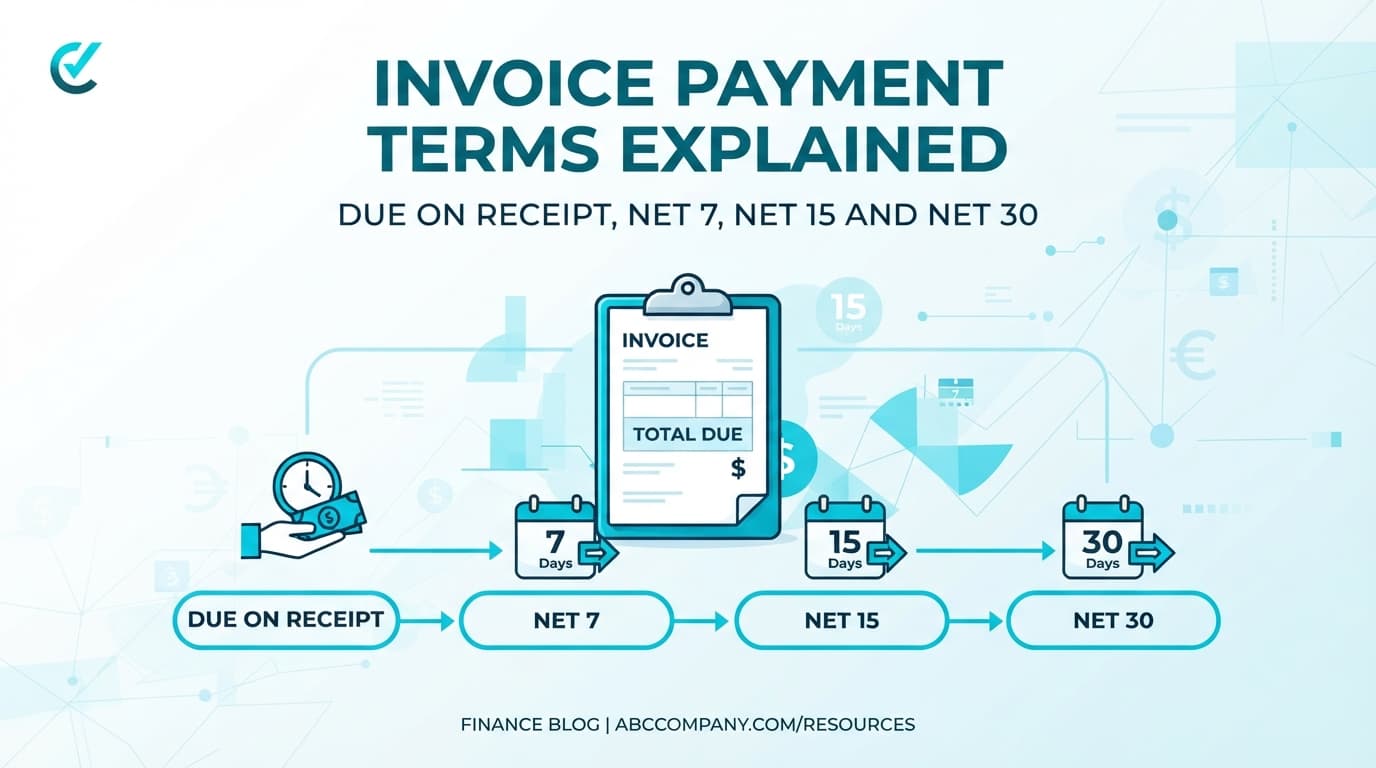
Most invoice payment problems do not start with a customer refusing to pay. They start with something much simpler: the customer is not entirely sure when they are supposed to pay.
Terms such as Due on Receipt, Net 7, Net 15 and Net 30 are used to set that deadline. They tell the customer how much time they have to pay an invoice and help both sides work from the same expectation.
But the terminology is not always obvious. Does Net 30 mean 30 business days? Does “Due on Receipt” literally mean the customer has to pay the moment they open the invoice? And when does the countdown actually begin?
This guide explains the most common invoice payment terms, shows how to calculate their due dates, and covers how to choose terms that make sense for your business.
What Are Invoice Payment Terms?
Invoice payment terms are the conditions that tell a customer when payment is due and, in some cases, what happens if payment is late.
For example, an invoice might say:
Payment Terms: Net 15Invoice Date: May 1, 2026Due Date: May 16, 2026
That tells the customer that the full invoice amount needs to be paid within 15 days of the invoice date.
Accounting platforms such as QuickBooks use terms including Due on Receipt, Net 15, Net 30 and Net 60 to calculate invoice due dates automatically. QuickBooks defines Due on Receipt as payment due immediately and Net 30 as payment due 30 days after the invoice date.
The important point is that payment terms should not leave the customer guessing. The clearer the deadline is, the easier it is for everyone involved to know whether an invoice is outstanding or actually overdue.
Quick Comparison: Due on Receipt vs Net 7 vs Net 15 vs Net 30
Assume you issue an invoice on May 1, 2026 and the payment period is calculated in calendar days from the invoice date.
Payment term | What it means | Example due date |
|---|---|---|
Due on Receipt | Payment is expected immediately when the invoice is received | May 1, 2026, if received that day |
Net 7 | Payment is due within 7 days | May 8, 2026 |
Net 15 | Payment is due within 15 days | May 16, 2026 |
Net 30 | Payment is due within 30 days | May 31, 2026 |
Net payment periods are generally expressed in calendar days rather than business days unless your agreement specifically says otherwise.
This is one reason I recommend putting both the payment term and the actual due date on an invoice.
“Net 30” is useful.
“Net 30 — Due May 31, 2026” is much harder to misunderstand.
What Does Due on Receipt Mean?
Due on Receipt means payment is expected as soon as the customer receives the invoice.
It is effectively the shortest standard invoice payment term. Instead of extending the customer several days or weeks of payment time, you are asking them to pay immediately.
Stripe describes Due on Receipt as payment being due as soon as the invoice is received, while QuickBooks similarly defines it as payment due immediately.
For example, imagine a photographer finishes a one-day commercial shoot on June 10 and emails the invoice that afternoon.
If the invoice says:
Payment Terms: Due on ReceiptDue Date: June 10
the photographer is communicating that payment is expected immediately rather than seven, fifteen or thirty days later.
However, Due on Receipt should not be confused with payment in advance.
With payment in advance, the customer pays before the work is completed or the goods are supplied. With Due on Receipt, the invoice has already been issued and payment becomes due when the customer receives it.
Due on Receipt can work particularly well for one-off jobs, small invoices, completed projects or situations where there is no reason to extend credit to the customer.
That does not mean every customer can process the payment instantly. A company may have an approval process or scheduled payment runs. For business customers, it is worth agreeing on payment expectations before doing the work instead of surprising the accounts department with immediate terms after delivery.
What Does Net 7 Mean on an Invoice?
Net 7 means the full invoice amount is due seven days after the starting date specified by the payment terms, commonly the invoice date.
If an invoice is dated August 3 and uses Net 7 terms, the due date would ordinarily be August 10.
Net 7 gives the customer a short amount of time to review the invoice, approve it and arrange payment without forcing the seller to wait several weeks.
For businesses that invoice frequently, shorter payment terms can also reduce the amount of money sitting in unpaid accounts receivable.
A Net 7 invoice might show:
Invoice Date: August 3, 2026Payment Terms: Net 7Due Date: August 10, 2026
There is little reason to make the customer calculate that date themselves. Display it prominently.
Net 7 may make sense when your business has short projects, relatively small invoices, established customers who can process payments quickly, or cash-flow requirements that make longer credit periods impractical.
Before adopting it universally, however, consider who your customers are. A large organisation with several layers of invoice approval may simply be unable to process an invoice within seven days.
What Does Net 15 Mean on an Invoice?
Net 15 means payment is due within 15 days.
For an invoice dated July 1, a 15-day payment period would result in a July 16 due date.
FreshBooks defines Net 15 as requiring full payment within 15 days of the invoice date.
Net 15 sits between immediate payment terms and the longer Net 30 arrangement. It gives customers some breathing room while allowing the seller to collect significantly sooner than they would under a 30-day term.
For many service businesses, consultants, freelancers and agencies, that can be a practical compromise.
For example:
Invoice Date: July 1, 2026Terms: Net 15Payment Due: July 16, 2026
Again, the specific date is more useful to your customer than the abbreviation alone.
What Does Net 30 Mean on an Invoice?
Of all the invoice payment terms, Net 30 is probably the one businesses encounter most often.
A Net 30 invoice gives the customer a 30-day payment window.
If the invoice is issued on September 1 and the payment period begins on the invoice date, payment would be due on October 1.
Net 30 is a form of trade credit: the seller supplies the product or service first and gives the buyer time to pay afterward. FreshBooks describes Net 30 as a credit term in which the seller provides the goods or performs the service before collecting payment.
That distinction matters.
When you offer Net 30, you are effectively financing that invoice for the payment period. You have already spent the time, labour or money required to deliver the product or service, but the cash may not arrive for several weeks.
For established business relationships, that may be perfectly reasonable. Net 30 is widely used in B2B transactions, and Stripe notes that it gives customers time to manage expenses while still providing the seller with a defined payment window.
For a small business with tight cash flow, however, automatically giving every customer 30 days to pay may not make sense.
Does Net 30 Mean 30 Business Days?
Usually, no.
Net 30 normally refers to 30 calendar days, not 30 working or business days. The same principle generally applies to Net 7 and Net 15.
If you want the payment period to use business days instead, say so explicitly.
More importantly, include the calculated due date directly on the invoice.
Instead of writing only:
Net 30
write:
Payment Terms: Net 30Due Date: October 1, 2026
That removes the need for the customer to calculate anything.
If your contract defines the payment period differently—for example, starting from invoice approval, delivery, receipt of the invoice or another event—the contract should be followed and your invoice should use wording consistent with that agreement.
Is Net 30 Calculated From the Invoice Date or the Date the Customer Receives It?
This is one area where businesses should avoid relying solely on shorthand.
Accounting systems commonly calculate Net terms from the invoice date. QuickBooks, for example, adds the selected payment term to the invoice date when calculating a due date.
Other commercial wording may define a payment period from receipt of the invoice instead. Stripe, for example, explains Net 30 as payment within 30 days of receiving an invoice.
Your contract may also specify its own starting point.
Instead of arguing later about which interpretation applies, make the deadline explicit:
Net 30 — Payment due October 1, 2026.
The date is what ultimately matters operationally.
Which Invoice Payment Terms Should You Choose?
There is no payment term that is automatically right for every business.
The best choice depends on your customer, your cash flow, the type of work you perform and whatever payment arrangement you agreed to before issuing the invoice.
If you need payment immediately after completing a small job, Due on Receipt may be appropriate.
If you want to give customers a short processing window, Net 7 provides one week.
Net 15 gives customers more flexibility without making you wait a full month.
Net 30 may be appropriate when working with established businesses, larger organisations or customers whose finance departments require longer processing periods.
The bigger principle is this: do not extend more payment time than your business can comfortably support simply because a term is common.
If paying suppliers, staff and operating expenses depends on collecting customer invoices quickly, that should influence the terms you agree to.
Payment terms are part of the commercial agreement between you and your customer, not just a piece of text you add when generating the invoice.
How to State Payment Terms Clearly on an Invoice
Good invoice wording does not need to sound like a legal contract.
It needs to answer a few practical questions: How much is owed? When is it due? How can the customer pay? And what happens if payment is late?
For example, instead of writing:
Terms: Net 15
you could write:
Payment Terms: Net 15. Full payment of $1,500 is due by September 16, 2026. Payment can be made by bank transfer using the details below.
That wording gives the customer both the industry shorthand and the exact deadline.
If you are preparing an invoice now, you can create a free PDF invoice and include the payment term and due date directly on the document.
Clarity matters more than sounding formal.
What About Late Fees on Overdue Invoices?
A late-payment clause can tell customers what happens when an invoice is not paid by its due date. But this is one area where businesses need to be careful.
There is no universal late-fee percentage that is automatically valid everywhere.
The rules can depend on the jurisdiction governing the transaction, whether the customer is a business or consumer, how the charge is classified, the terms of the underlying contract and whether the fee or interest rate was properly agreed.
Different jurisdictions take different approaches. For example, the UK has statutory rules covering interest on qualifying late commercial payments, while EU rules provide separate frameworks for certain commercial transactions.
That is why copying something like “5% late fee per month” from another company's invoice is not a good compliance strategy.
If you intend to charge late fees or interest, make sure the terms comply with the law that applies to your transaction and are communicated clearly as part of your agreement with the customer. For significant contracts or uncertainty about what you can legally charge, obtain advice appropriate to your jurisdiction.
An invoice generator can help you display a late-payment clause, but it cannot determine whether that clause is legally enforceable in your particular location.
Should You Put Both Payment Terms and a Due Date on an Invoice?
Yes, in most cases that is the clearest approach.
“Net 30” may be perfectly understandable to an accounts-payable professional, but a small-business customer may have no idea what it means.
A specific due date removes the interpretation.
Compare:
Payment Terms: Net 30
with:
Payment Terms: Net 30 — Payment due October 21, 2026
The second version communicates the same thing without requiring the recipient to count days.
This also helps when following up on overdue invoices. Instead of debating when the 30-day period started, you can refer directly to the due date shown on the invoice.
Due on Receipt vs Net 7 vs Net 15 vs Net 30: Which Is Better?
Think of these terms as different amounts of credit extended to your customer.
Due on Receipt provides essentially no payment window after receipt.
Net 7 provides a short window.
Net 15 gives the customer roughly two weeks.
Net 30 gives them about a month.
The right choice is the one that matches the commercial relationship you actually have with the customer.
A freelancer completing a one-off project may not want to finance a client's invoice for 30 days. A supplier working with a large company may find that Net 30 fits naturally with the company's accounts-payable process.
You can also use different terms for different customers rather than adopting one policy for everyone.
Whatever you choose, agree on it before payment becomes an issue.
Frequently Asked Questions About Invoice Payment Terms
What does Net 30 mean on an invoice?
Net 30 means the customer has a 30-day payment period. It is commonly calculated from the invoice date, although the agreement between the parties may specify another starting point. Always include the actual due date to avoid ambiguity.
What does Due on Receipt mean?
Due on Receipt means payment is expected as soon as the customer receives the invoice. It does not mean payment before the work is performed; that would be an advance or prepayment arrangement.
What does Net 7 mean?
Net 7 means the invoice is due seven days after the relevant starting date, typically the invoice date.
What does Net 15 mean?
Net 15 gives the customer 15 days to pay the invoice.
Are Net 30 terms based on business days?
Net payment periods are generally expressed in calendar days unless your contract or invoice states otherwise. If you mean business days, make that clear in writing.
Can I charge a late fee after 30 days?
Potentially, but you should not assume that any late fee or interest rate you choose will automatically be enforceable. Late-payment laws and contract requirements vary between jurisdictions and transaction types. Check the rules that apply to your business before setting a late-fee policy.
The Bottom Line
Invoice payment terms do one simple but important job: they tell your customer when you expect to be paid.
Due on Receipt means payment is expected immediately. Net 7 gives the customer seven days, Net 15 gives them 15 days, and Net 30 provides a 30-day payment window.
Whichever term you use, do not make the customer work out the deadline themselves.
Include both the payment term and a specific due date, make sure the terms match whatever you agreed with the customer, and clearly explain any payment or late-payment conditions that apply.
When you're ready to send your next invoice, you can create a free PDF invoice with your customer details, line items, payment terms and due date included.
Put this into practice
Use the Invoice tool for the calculation, then read What a payment receipt should include for the supporting explanation.