Invoice vs Bill: What’s the Difference?
Confused by invoice vs bill? Learn the key differences between these payment requests, when to use each term, and how they impact your business accounting.
Published · Updated · By ToolNimbly
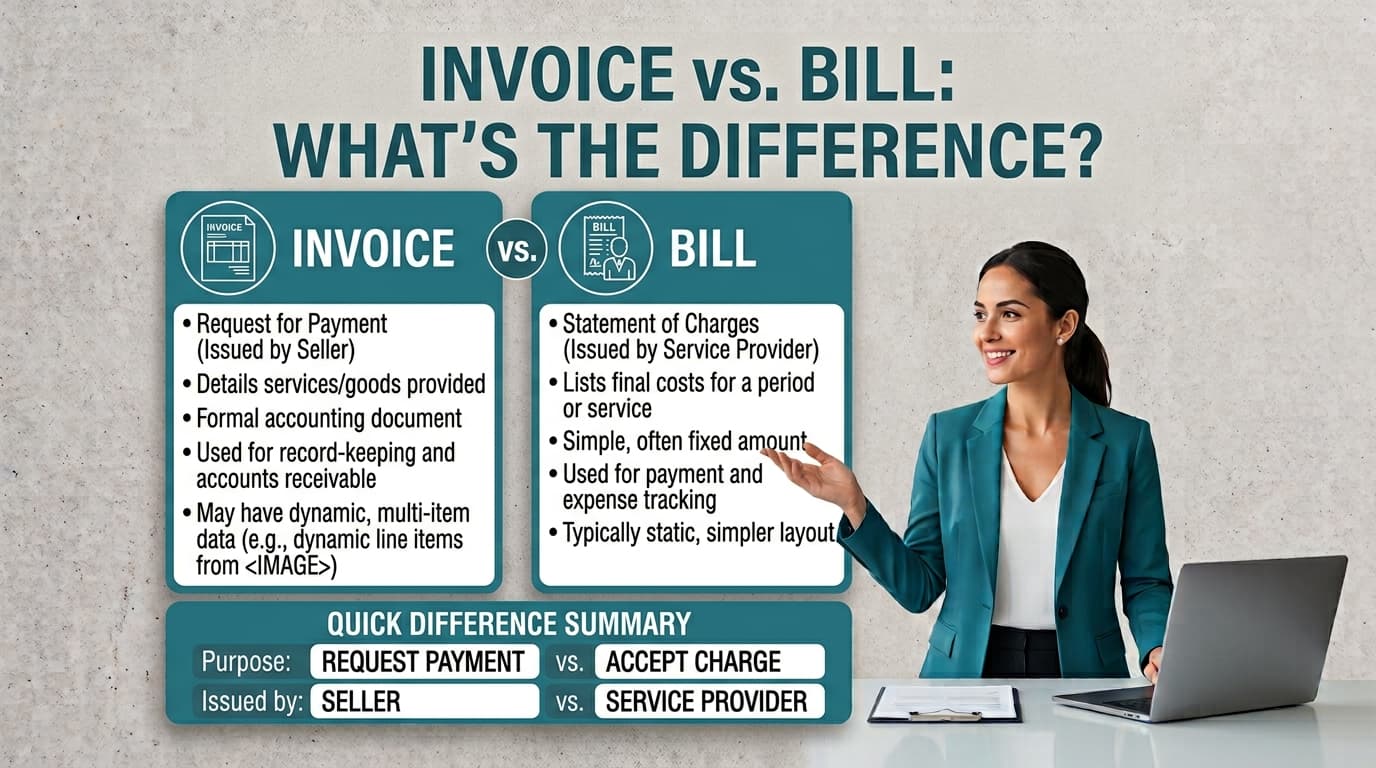
In the world of small business and freelance accounting, terminology matters. If you are starting your own venture, you have likely encountered the terms "invoice" and "bill" used interchangeably. While they are related, they serve distinct roles in your financial operations and professional communication.
The core difference is simple: an invoice is a formal, itemized request for payment sent by a seller, while a bill is a general term for a request for payment. The distinction often comes down to your perspective. The same document is an invoice to the person who sent it and a bill to the person who received it.
The Perspective Rule: Who Are You?
To understand the difference, look at your position in the transaction.
When you provide a service or sell a product to a client, you issue an invoice. This document acts as a record of the sale, detailing what was provided and the terms under which payment is expected. From your side, this document is a tool for tracking your Accounts Receivable, which represents the money your business is owed.
Conversely, when you receive a request for payment for services or goods you have purchased, you categorize that document as a bill. For your business, this falls under Accounts Payable, representing the money you owe to others.
Is an invoice a bill? Technically, an invoice is a specific type of bill. However, calling a formal business-to-business request for payment a "bill" can sound informal. Using the correct terminology helps maintain a professional standard that clarifies expectations for both parties.
When to Use 'Invoice' in Your Business
In a professional setting, using the term "invoice" is standard practice. It signals that the document is a formal request that carries specific payment terms.
An invoice serves several functions:
Establishing Terms: An invoice can state when payment is expected, such as "Net 30," helping you manage your cash flow.
Record Keeping: By providing a detailed, itemized list of goods or services, an invoice creates a clear trail for your own internal financial records.
Professionalism: Sending a structured, clear document demonstrates that your business operates with defined processes.
If you are looking for a straightforward way to create these documents, you can make an invoice using our generator. This tool allows you to create, format, preview, print, or download an invoice as a PDF. It supports business and client details, an invoice number, issue and due dates, currency, line items, payment instructions, terms, notes, discounts, one document-level tax, shipping or fees, paid amount, and balance due. The tool calculates line totals, subtotal, discounts, tax, fees, total, paid amount, and balance due using exact decimal arithmetic. Users can add, remove, and reorder line items and add a logo, which is processed locally. Because it requires no signup and sends no invoice data to a server, it is a private way to generate professional documentation.
The Receiver’s Perspective: Understanding Bills
While "invoice" is the preferred term for outbound requests, the term "bill" is common in everyday business and consumer operations. A bill is typically a request for immediate payment.
Consider the utility statement for your office or the check you receive at a business lunch. These are generally not referred to as invoices because they are often for standardized, recurring, or immediate transactions where the scope of work is already understood and requires no further negotiation or itemization.
It is also important to distinguish a bill from a bill of sale. A bill of sale is a document that transfers ownership of an asset from one party to another. An invoice, by contrast, is a request for payment for goods or services that may or may not involve the transfer of ownership of a physical asset.
Best Practices for Documentation
Maintaining a consistent, professional approach to your documentation is one of the most effective ways to keep your business organized. Proper documentation is the backbone of accurate financial record-keeping.
When you use the term "invoice" consistently for your sales, you create a clear trail of income for your records. This consistency helps you track your revenue and identify outstanding payments efficiently. Keeping your records labeled correctly makes the process of preparing for tax season smoother.
If you are just starting out, keep these best practices in mind:
Be Consistent: Use the same naming conventions for your documents throughout the year.
Include Essential Data: An invoice often identifies the seller, the buyer, the date of issue, a unique invoice number, and a detailed breakdown of the items or services provided.
Maintain Records: Keep copies of all issued invoices and received bills in a secure, organized system.
While documentation is essential, remember that this overview is provided for educational purposes. Because requirements for documentation can vary by jurisdiction and industry, it is a sound practice to consult with a qualified accountant or tax professional regarding your specific business needs.
Workflow: Managing Your Invoices
To maintain a professional workflow, consider the following steps when preparing to send an invoice:
Verify the Details: Before generating the document, ensure you have the correct client contact information and the agreed-upon price for the goods or services.
Itemize Clearly: Use clear, descriptive language for each line item. Instead of "Consulting," use "Strategic planning session - 2 hours." This reduces client confusion.
Set Clear Terms: Clearly state the payment due date. If you offer a discount for early payment or charge a fee for late payment, ensure these terms are defined on the document.
Review for Accuracy: Check the math. Ensure that the subtotal, any applicable taxes or fees, and the final balance due are correct.
Professional Presentation: Use a clean, consistent template. Including your business logo helps reinforce your brand identity.
Frequently Asked Questions
Should I call it an invoice or a bill?For professional business-to-business services, use "invoice." It signals to your client that this is a formal request for payment with specific terms. Use "bill" for immediate consumer-style payments or recurring utility-style costs where detailed itemization is not the primary focus.
Does the difference matter for my records?While the primary concern is the accuracy of your income and expense reporting, using the correct terminology is part of maintaining high-quality business records. Consistent, well-documented invoices make it easier to substantiate your business activities.
What should I do if a client disputes an invoice?If a client disputes an invoice, address the issue promptly and professionally. Review your original agreement or contract to clarify the scope of work and the agreed-upon pricing. Maintain a written record of all communications regarding the dispute. If the issue remains unresolved, consult with a professional advisor.
How should I handle payment instructions?When including payment instructions on an invoice, ensure they are clear and easy to follow. Provide the necessary information for the client to remit payment, such as bank transfer details or a link to a payment portal. Avoid including sensitive personal identifiers on the document itself.
Is an invoice a receipt?No. An invoice is a request for payment sent before the transaction is completed. A receipt is a document provided after the payment has been received, serving as proof that the transaction has been settled.
Can I use the same template for every client?Yes, using a consistent template is a best practice. It saves time and ensures that your business presents a professional, unified image. Ensure that each document is customized with the specific client details and transaction information for that particular sale.
What if I make a mistake on an invoice?If you discover an error on an invoice that has already been sent, contact the client immediately. Provide a corrected version of the document and clearly mark it as a revision. Maintaining transparency is key to preserving professional relationships.
How long should I keep my invoices?Record retention requirements vary by jurisdiction and business type. It is recommended to consult with a tax professional or accountant to determine the appropriate retention period for your specific business records.
Does ToolNimbly provide tax or legal advice?No. ToolNimbly provides tools for generating documents. It does not provide accounting, tax, or legal advice. Always consult with a qualified professional regarding your specific business needs and compliance requirements.
Put this into practice
Use the Invoice tool for the calculation, then read What a payment receipt should include for the supporting explanation.