Invoice vs Receipt: What Is the Difference and When Do You Use Each?
Learn the difference between an invoice and a receipt, when to use each, what details they should include, and how both support accurate business recordkeeping.
Published · Updated · By ToolNimbly
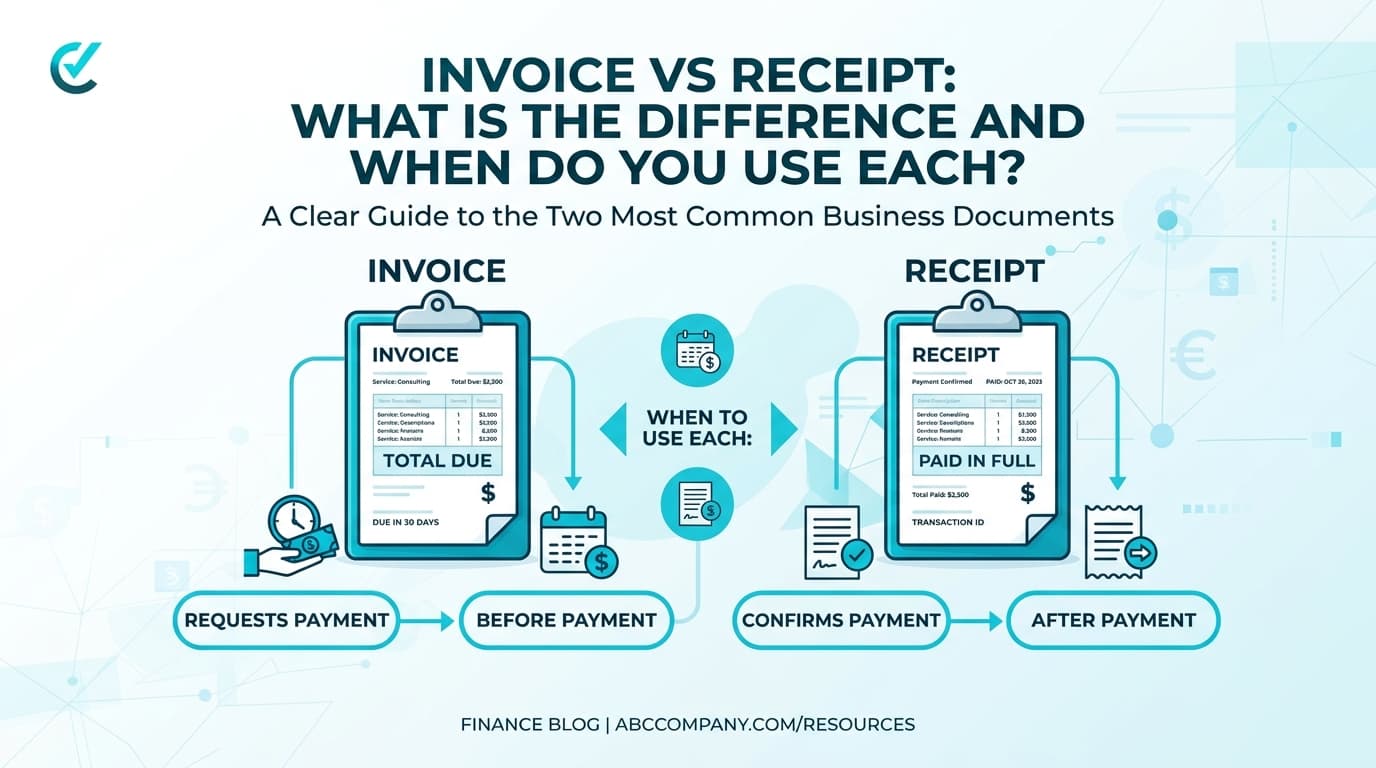
Invoices and receipts can look surprisingly similar. Both may contain a business name, customer details, a list of products or services, taxes and a total amount.
But they serve very different purposes.
The simplest way to understand the difference between an invoice and a receipt is this:
An invoice asks for payment. A receipt confirms payment.
If you have completed work for a client and they still owe you $500, you would normally send an invoice. Once that $500 has been paid, you can issue a receipt confirming that the payment was received.
That before-and-after distinction is the key to understanding invoice vs receipt. But there are a few additional differences businesses should know, particularly when it comes to payment terms, recordkeeping and the information each document should contain.
Invoice vs Receipt: Quick Comparison
Invoice | Receipt | |
|---|---|---|
Main purpose | Request payment | Confirm payment |
Usually issued | Before payment | After payment |
Shows amount owed? | Yes | Usually shows amount paid |
Includes a due date? | Usually | Usually not necessary |
Includes payment terms? | Often | Usually not |
Shows payment method? | Sometimes as instructions | Often |
Used for recordkeeping? | Yes | Yes |
Indicates the transaction is paid? | Not necessarily | Yes |
The distinction is not just accounting terminology. It tells the person receiving the document what they are expected to do next.
When someone receives an invoice, there is normally an outstanding payment to make.
When someone receives a receipt, the payment has already been made.
Stripe similarly describes an invoice as a formal request for payment issued before payment, while a receipt is issued afterward as confirmation that the customer paid.
What Is an Invoice?
An invoice is a document a seller or service provider sends to a customer requesting payment for goods or services.
It records what was supplied, how much the customer owes and, where applicable, when the payment needs to be made.
Imagine you are a freelance web designer.
You agree to build a landing page for a client for $1,200. You complete the work on March 10 and give the client 15 days to pay.
Your invoice might say:
Invoice #1042Invoice Date: March 10, 2026Website Design: $1,200Total Due: $1,200Payment Terms: Net 15Due Date: March 25, 2026
At this point, the invoice does not prove that the client has paid you.
It proves that you billed the client.
Once they pay the $1,200, the status of the transaction changes. That is when a receipt becomes useful.
If you need to bill a customer, you can create an invoice online with the customer details, line items, total and payment terms included.
What Is a Receipt?
A receipt confirms that money has been received for a transaction.
Instead of telling the customer what they still owe, it documents what they have already paid.
Using the previous example, suppose the web-design client pays the full $1,200 on March 18.
A receipt might show:
Receipt #R-1042Payment Date: March 18, 2026Website Design: $1,200Amount Paid: $1,200Payment Method: Bank TransferPayment Status: Paid
The receipt closes the payment side of the transaction.
It gives the customer a document they can keep as evidence of the purchase and gives the seller another record to match against the original invoice and payment received.
If payment has already been made, you can create a receipt rather than sending another invoice.
The Biggest Difference: Before Payment vs After Payment
This is the easiest rule to remember.
An invoice normally comes before payment
An invoice tells the customer:
“Here is what you owe.”
It may include a future payment deadline, such as Due on Receipt, Net 7, Net 15 or Net 30.
The transaction might eventually be paid, partially paid, overdue or cancelled. Simply having an invoice does not tell you that the money actually reached the seller.
A receipt comes after payment
A receipt tells the customer:
“We received your payment.”
It records a completed payment rather than requesting one.
Stripe recommends updating the business's records when payment is received and sending the customer a receipt to confirm the transaction.
That means a single sale can legitimately produce both an invoice and a receipt.
They are not duplicates. They document different stages of the same transaction.
A Simple Invoice and Receipt Example
Suppose a cleaning company provides monthly office cleaning for a business.
The agreed monthly price is $800.
On April 1, the cleaning company completes the month's work and issues:
Invoice #2041 — $800 due April 15
The customer has now been billed $800, but no payment has been received.
On April 12, the customer transfers $800 to the cleaning company.
The cleaning company can then issue:
Receipt #R-2041 — $800 received April 12
The accounting trail now tells the entire story:
Invoice: We charged the customer $800.
Payment: The customer transferred $800.
Receipt: We confirmed that the $800 payment was received.
This is why it is useful to keep invoices and receipts linked using invoice numbers, receipt numbers, customer names or transaction references.
What Information Should an Invoice Include?
The exact requirements for invoices can vary depending on your jurisdiction, industry and tax obligations, but professional invoices generally contain enough information to clearly identify the parties, transaction and payment obligation.
Common invoice fields include:
The word Invoice
Your business or seller name
Business contact information
Customer or client information
A unique invoice number
Invoice date
Description of each product or service
Quantity or hours, where relevant
Unit price or rate
Subtotal
Taxes, if applicable
Discounts or additional fees, if applicable
Total amount due
Payment terms
Payment due date
Payment instructions
Stripe's invoicing guidance similarly identifies details such as invoice numbers, issue dates, due dates, seller and buyer information, itemized products or services, taxes, totals and payment terms as common invoice components.
The most important thing is that your customer should be able to look at the invoice and immediately understand three things:
What am I being charged for?
How much do I owe?
When and how do I pay?
If those answers are not obvious, the invoice needs work.
What Information Should a Receipt Include?
Receipts overlap with invoices in some areas. Both documents might show the business name, customer information, products or services and transaction total.
The difference is that a receipt should make the completed payment clear.
Typical receipt information can include the receipt number, transaction date, goods or services purchased, total paid, payment method and a transaction reference where relevant.
For example:
Amount Paid: $350
is more appropriate on a receipt than:
Amount Due: $350
because the receipt is supposed to confirm that payment already occurred.
We have a separate guide explaining what a payment receipt should include if you need a more detailed breakdown. There is no need to turn every receipt into a complicated accounting document; it simply needs to clearly document the transaction and payment.
Do You Need a Receipt If You Already Have an Invoice?
Sometimes businesses assume the original invoice is enough.
But an unpaid invoice and proof of payment are not the same thing.
Suppose you receive an invoice for $2,000 in January.
If you look at that invoice six months later, it may still say:
Total Due: $2,000
That document alone does not tell you whether the $2,000 was eventually paid.
You would need your payment records, a paid version of the invoice, a receipt or another form of payment confirmation to establish that.
Some invoicing systems update invoices to show a Paid status once payment has been received. In that situation, the updated invoice may also help document payment.
However, issuing a separate receipt can provide a clearer confirmation for the customer, particularly when they need proof of payment for expenses, reimbursements or their own bookkeeping.
Can an Invoice Be Used as a Receipt?
Not automatically.
An ordinary invoice states what a customer was charged. It does not necessarily prove that the customer paid it.
An invoice marked Paid may provide evidence that the seller recorded payment, particularly if it also shows the payment date and amount received.
But if you want to provide customers with an unmistakable payment confirmation, a receipt is clearer.
Think about the wording:
Invoice #4007 — Amount Due: $750
versus:
Receipt #4007 — Amount Paid: $750 on July 21
There is very little room for confusion in the second document.
Can You Issue a Receipt Without an Invoice?
Yes.
Not every transaction requires an invoice first.
Think about a coffee shop.
You order a coffee, pay immediately and receive a receipt. There is little reason for the shop to send you an invoice requesting payment because the sale and payment happen almost simultaneously.
Retail purchases commonly work this way.
Invoices become more useful when payment does not happen immediately—for example, when a consultant performs work today but gives the customer 15 days to pay.
That is why invoices are especially common in service businesses, wholesale transactions and B2B relationships.
Why Businesses Should Keep Both Invoices and Receipts
Invoices and receipts are useful beyond simply communicating with customers.
Together they can help businesses track:
What was sold
What was billed
What remains unpaid
What has already been paid
When payment was received
Where income came from
Business expenses and purchases
Good recordkeeping also becomes important when preparing accounts, reconciling bank transactions or supporting tax records.
For example, the U.S. Internal Revenue Service lists both invoices and receipts among the supporting documents businesses may use to substantiate transactions and entries in their books.
The exact documents you are legally required to keep—and how long you need to keep them—depend on the tax and recordkeeping rules that apply in your jurisdiction. Do not assume that another country's retention period automatically applies to your business.
Operationally, though, keeping an organized trail is useful regardless of jurisdiction.
If invoice #1025 says a customer owes $900, your records should eventually allow you to determine whether invoice #1025 remains outstanding or was paid.
Without that connection, bookkeeping becomes unnecessarily difficult.
Invoice vs Receipt for Freelancers
Freelancers commonly need both documents.
Imagine you are a photographer charging $600 for an event.
Once the job has been completed, you send the client an invoice:
Photography Services: $600Payment due: August 15
The client pays you on August 10.
You can then issue a receipt:
$600 received on August 10
The invoice helped you collect the money.
The receipt helped you document that you received it.
Invoice vs Receipt for Small Businesses
The same principle applies to small businesses.
A furniture maker completing a custom order might send an invoice asking the customer to pay the remaining balance.
A convenience store, on the other hand, will usually take payment immediately and provide a receipt.
One business may even use both workflows.
A computer store might issue receipts for customers purchasing laptops at the counter but issue Net 30 invoices to corporate customers buying 20 computers on agreed credit terms.
The correct document depends less on the type of company and more on the stage of the transaction.
Invoice vs Receipt for Recordkeeping
A useful way to organize your records is to think of the documents as a sequence:
Sale or work completed → Invoice issued → Payment received → Receipt issued
Not every transaction follows that exact sequence, but it works well for businesses that allow customers to pay after goods or services have been supplied.
Give every invoice a unique number.
Give receipts their own unique numbers where appropriate.
When possible, reference the original invoice on the receipt.
For example:
Receipt: R-2026-0081Related Invoice: INV-2026-0142
Now, if you search your records a year later, you can easily connect the request for payment with the confirmation of payment.
What Should You Send: An Invoice or a Receipt?
Ask yourself one question:
Has the customer already paid?
If the answer is no, and you need to request payment, you probably need an invoice.
You can create an invoice, enter the items or services provided, set the amount due and add your payment terms.
If the answer is yes, and you want to document or confirm that payment, you probably need a receipt.
You can create a receipt showing what the customer purchased and how much they paid.
In some transactions, you will create both.
Frequently Asked Questions About Invoices and Receipts
What is the difference between an invoice and a receipt?
An invoice requests payment for goods or services. A receipt confirms that payment has already been made.
Does an invoice mean something has been paid?
No. An invoice by itself normally indicates that an amount has been billed. It does not prove payment was made.
Is a receipt proof of payment?
A receipt is intended to document and confirm payment for a transaction. Depending on the situation, other documents such as bank records, card statements or electronic payment confirmations may also be relevant evidence of payment.
Do I send an invoice before or after payment?
Invoices are generally issued before payment is received. Depending on the business arrangement, they may be sent before work starts, during a project, when goods are delivered or after work has been completed but before the customer pays.
Do I send a receipt before or after payment?
A receipt is issued after payment because its purpose is to confirm that the transaction has been paid.
Is an invoice number the same as a receipt number?
Not necessarily. Businesses can maintain separate numbering systems for invoices and receipts. What matters is that the records are organized and that individual documents can be identified and traced when needed.
Can I create both an invoice and a receipt for the same transaction?
Yes. This is common. The invoice records the amount you billed the customer, while the receipt confirms the later payment.
The Bottom Line
When comparing an invoice vs receipt, the easiest distinction is timing.
An invoice comes before payment and requests money. A receipt comes after payment and confirms money was received.
An invoice tells your customer how much they owe, what they are paying for and when payment is due.
A receipt records what they paid, when they paid it and, where useful, how the payment was made.
For transactions where customers pay later, businesses will often use both: first an invoice, then a receipt when payment arrives.
If you are waiting to be paid, create an invoice.
If the customer has already paid and needs confirmation, create a receipt.
Using the correct document at the correct stage keeps communication clearer for your customers and makes your own financial records much easier to follow.
Put this into practice
Use the Invoice tool for the calculation, then read What a payment receipt should include for the supporting explanation.