Musician Invoice Template: Guide and Example
Need a professional musician invoice template? Learn how to bill for gigs, rehearsals, and travel, and make a musician invoice easily with our guide.
Published · Updated · By ToolNimbly
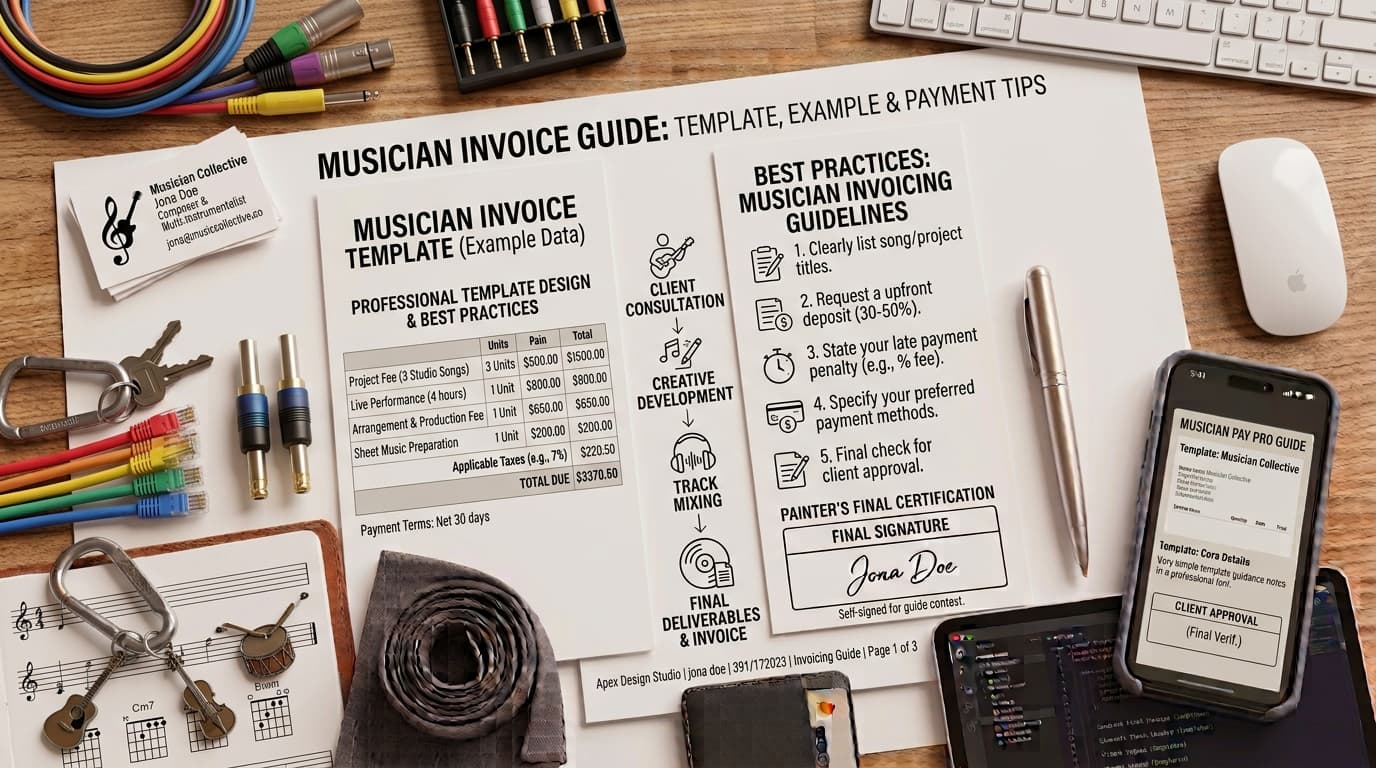
For many musicians, the transition from creative work to administrative tasks can feel like a significant shift in focus. However, developing a consistent approach to billing is a practical way to manage your business operations. A clear, well-structured invoice serves as a professional request for payment and provides a record of the services you have provided. By organizing your billing process, you can maintain better clarity regarding your work and the status of your payments.
Why Musicians Use Professional Invoices
When you provide a formal invoice, you are creating a record of the services you performed. This documentation is useful for your own bookkeeping and helps you track your business activity over time. Maintaining organized records of your income is a standard practice for any professional, as it allows you to review your earnings and manage your business finances effectively.
Beyond internal record-keeping, a professional invoice communicates your business standards to venues, event planners, and private clients. A clear document that outlines the work performed and the amount due helps minimize ambiguity. When your billing is consistent and easy to read, it reflects your professionalism and helps ensure that your clients have the information they need to process your payment.
Common Components of a Musician Invoice
While there is no single required format for an invoice, certain fields are commonly used to ensure the document is informative for both you and your client. To maintain a professional appearance, you might consider including the following elements:
Contact Information: Your name or stage name, along with your professional contact details. It is also helpful to include the name and contact information of the client or the business entity you are billing.
Invoice Number: Assigning a unique identifier to each document helps you keep your records organized. You might choose a simple system, such as 2024-001, to track your billing history.
Dates: Include the date the invoice was issued and a clear due date for the payment. Providing a specific date helps both parties understand the expected timeline for the transaction.
Line Items: A breakdown of your services allows the client to see exactly what is being billed. This transparency is helpful for clarifying the scope of the work.
Payment Instructions: Clearly state the methods you accept for payment, such as bank transfers or digital payment platforms.
Example: Structuring Your Line Items
To provide clarity, use specific line items that reflect the details of your engagement. Below is a hypothetical example of how you might structure these charges for a performance:
Performance Fee: $500.00 (Flat fee for a 3-hour set at Event Name).
Deposit: -$100.00 (Amount previously paid to secure the date).
Rehearsal: $150.00 (3 hours of pre-show rehearsal at $50/hour).
Travel: $45.00 (Mileage reimbursement for 75 miles).
Equipment Rental: $75.00 (PA system rental and setup fee).
Total: $670.00
By separating these items, you provide a clear calculation of the final amount. If a client has questions about the total, they can easily review the individual components, which often facilitates a smoother payment process.
How to Manage Your Invoicing Efficiently
Drafting invoices manually can be time-consuming and may lead to formatting inconsistencies. Using a dedicated system helps ensure that your documents remain professional and organized. You can make a musician invoice by using a template that allows you to input your data, calculate totals, and generate a document that you can print or download as a PDF.
When using a digital generator, consider storing your completed invoices in a secure, backed-up location. Keeping a consistent archive of your billing documents makes it easier to track which payments are outstanding and which have been settled. Because digital tools do not maintain a permanent server-side database, it is your responsibility to save your files locally or in a secure cloud storage service to ensure you have access to your records when needed.
Best Practices for Invoicing Success
Consistency is a key factor in maintaining a steady workflow. Many musicians find that sending an invoice shortly after a performance or project completion is more effective than waiting. Establishing a standard routine, such as sending your invoice within 24 hours of an event, helps keep your administrative tasks manageable.
Your invoice is a touchpoint in your professional relationship. A clean, error-free document reflects well on your brand. If you are a bandleader, ensure that your invoice clearly distinguishes between your personal services and the services provided by other band members if you are handling the distribution of funds.
If you encounter a client who consistently pays late, consider having a conversation about their payment cycle. Sometimes, a simple adjustment to your billing date can align better with their internal accounting processes. Always maintain a professional tone in your correspondence, even when following up on an outstanding balance.
Tax and Legal Considerations
The classification of your work as an independent contractor or an employee depends on the specific facts and circumstances of your working relationship. If a venue or employer exercises significant control over the methods, tools, and schedule you use, they may be required to treat you as an employee. You can find more information on these distinctions through the IRS.
Regarding tax reporting, businesses may be required to file specific forms, such as the 1099-NEC, if they pay an independent contractor a certain amount in a calendar year. You should maintain your own records of all payments received to ensure your documentation is accurate.
Tax laws and requirements regarding sales tax or professional services can vary significantly by state and municipality. Because these rules are subject to change and depend on your specific location, you should research your local requirements or speak with a qualified accountant to determine if you need to collect or remit tax on your performance or production fees.
Frequently Asked Questions
Do I need an EIN to send an invoice?You are not required to have an Employer Identification Number (EIN) to send an invoice, but some musicians choose to obtain one to keep their business affairs separate from their personal life. You can learn more about EINs through the IRS.
How should I handle late payments?The best approach to late payments is to have clear terms established in your agreement with the client. If a payment is late, send a polite reminder email shortly after the due date. Keeping a record of all communications is a helpful practice if you need to follow up on an outstanding balance.
What if my client refuses to pay?If a client does not pay, refer back to your signed agreement. If the amount is significant, you may need to consult with a legal professional. Always keep detailed records of your work and all communications, as these will be important if you need to pursue further action.
Should I charge sales tax on my services?Tax treatment for professional services varies by jurisdiction. Some regions may require you to collect sales tax, while others may exempt your services. Because these laws are specific to your location, consult with a local tax professional to understand your obligations.
DisclaimerThis information is for educational purposes and does not constitute legal or tax advice. Laws regarding worker classification and tax reporting can vary by state and individual circumstance. Always consult with a qualified accountant or tax professional regarding your specific business situation.
Put this into practice
Use the Invoice tool for the calculation, then read What an invoice needs to contain for the supporting explanation.