The Rule of 72: Estimate How Long It Takes Money to Double
Learn how the Rule of 72 estimates how long it takes money to double, see examples at different rates, and know when to use a compound interest calculator.
Published · Updated · By ToolNimbly
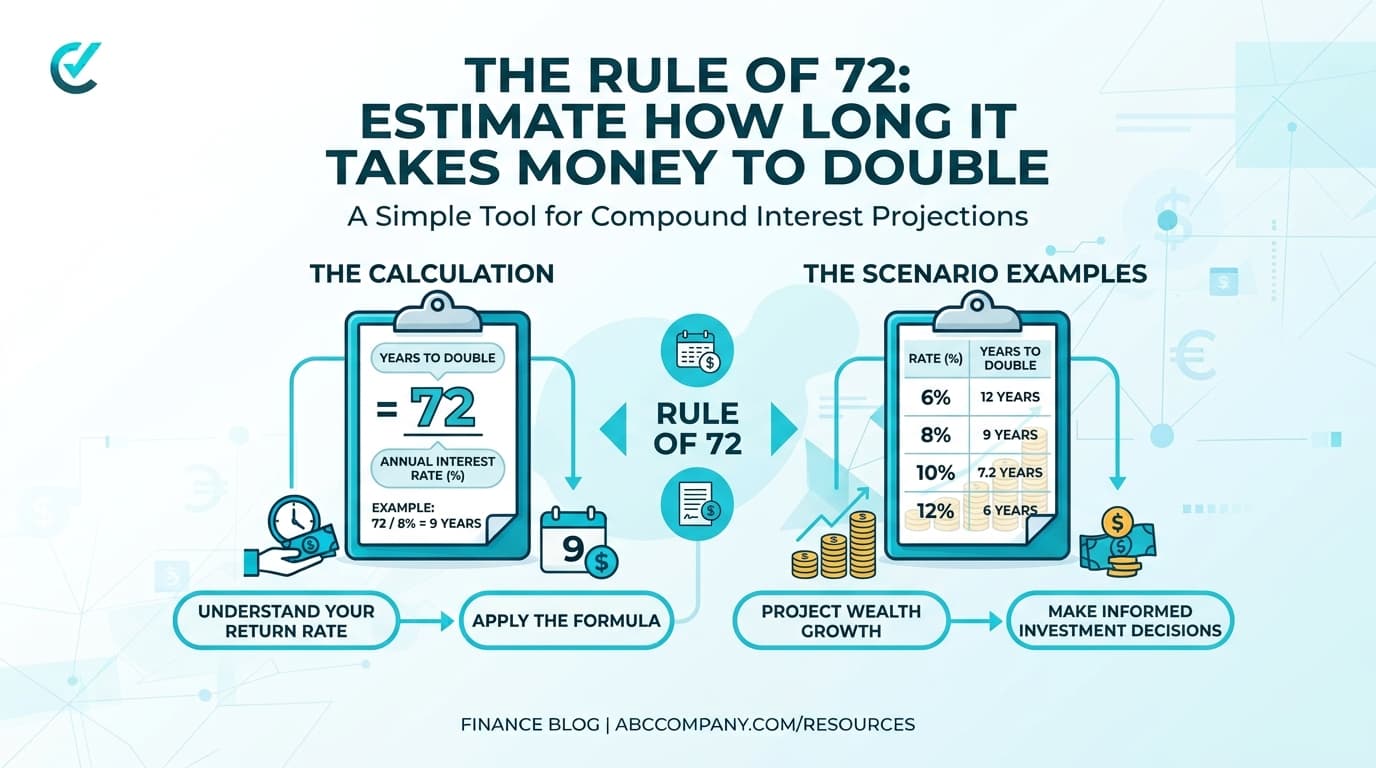
If your money earns interest or investment returns over time, one of the first questions you might ask is simple:
How long will it take my money to double?
You could calculate the answer using a compound interest formula, a spreadsheet or a financial calculator. But if you only need a quick estimate, there is a much easier shortcut.
It is called the Rule of 72.
The Rule of 72 lets you estimate the number of years it could take money to double by dividing 72 by the annual rate of return.
For example, at an 8% annual rate:
72 ÷ 8 = 9
So money growing at 8% per year would take approximately 9 years to double, assuming the rate remained constant and the earnings were compounded.
The U.S. Securities and Exchange Commission's Investor.gov describes the Rule of 72 as a way to estimate how long an investment could take to double based on its expected rate of return.
It is useful mental math, but it is important to understand what the calculation does and does not tell you.
What Is the Rule of 72?
The Rule of 72 is a shortcut for estimating the doubling time of money that grows through compounding.
The formula is:
Years to double ≈ 72 ÷ annual interest or return rate
You enter the annual rate as a whole number, not as a decimal.
So if the rate is 6%, you calculate:
72 ÷ 6 = 12 years
If the rate is 9%:
72 ÷ 9 = 8 years
If the rate is 12%:
72 ÷ 12 = 6 years
The calculation does not tell you exactly how much money you will have at every point along the way. It simply provides a quick estimate of how long a starting amount could take to become twice as large.
How Does the Rule of 72 Work?
The Rule of 72 works because compound growth is exponential.
With compound interest, you do not earn interest only on your original amount. You can also earn interest on interest that has already accumulated.
Investor.gov gives a simple example of this concept. If $100 earns 5% in the first year, it becomes $105. During the second year, interest can be earned on the full $105 rather than only on the original $100.
Over a long enough period, this compounding can make a significant difference.
The Rule of 72 gives you a quick way to estimate that effect without working through every year's balance.
Rule of 72 Examples at Different Rates
Here is what the Rule of 72 produces at several hypothetical annual growth rates:
Annual rate | Rule of 72 calculation | Estimated time to double |
|---|---|---|
2% | 72 ÷ 2 | 36 years |
4% | 72 ÷ 4 | 18 years |
5% | 72 ÷ 5 | 14.4 years |
6% | 72 ÷ 6 | 12 years |
8% | 72 ÷ 8 | 9 years |
9% | 72 ÷ 9 | 8 years |
10% | 72 ÷ 10 | 7.2 years |
12% | 72 ÷ 12 | 6 years |
The Federal Reserve Bank of St. Louis uses the same calculation when teaching compound interest. Its examples include 2% taking approximately 36 years to double and 12% taking approximately six years.
Notice how much the estimated doubling period changes as the rate increases.
At 4%, the estimate is 18 years.
At 8%, it falls to about 9 years.
That does not mean an 8% investment is guaranteed to double in nine years. It means that if an amount actually compounded at a consistent 8% annual rate, the Rule of 72 estimates a doubling period of approximately nine years.
That distinction is important.
Rule of 72 Example: $1,000 at 6%
Suppose you start with $1,000 and assume a constant annual growth rate of 6%.
Using the Rule of 72:
72 ÷ 6 = 12
The estimate says your $1,000 could take approximately 12 years to become $2,000.
The interesting part is that the starting amount does not affect the estimated doubling time.
Under the same assumptions:
$500 would take approximately 12 years to become $1,000.
$5,000 would take approximately 12 years to become $10,000.
$50,000 would take approximately 12 years to become $100,000.
The Rule of 72 is estimating the time required to grow by 100%, not the amount of money involved.
Rule of 72 Example: $10,000 at 8%
Now suppose you have $10,000 growing at a hypothetical 8% annual rate.
The calculation is:
72 ÷ 8 = 9
The estimate suggests that $10,000 could become approximately $20,000 after nine years.
If the same rate continued for another approximate doubling period, $20,000 could then become about $40,000.
This shows why compounding becomes more noticeable over longer periods. Each new period of growth starts with a larger balance.
Again, this example assumes a constant rate and no withdrawals or additional contributions. Real-world results can differ.
How Accurate Is the Rule of 72?
The Rule of 72 is surprisingly useful, but it is still a shortcut.
For annually compounded growth, the exact mathematical doubling period can be calculated using logarithms:
Exact doubling time = ln(2) ÷ ln(1 + r)
where r is the annual rate expressed as a decimal.
You do not need to use this formula for ordinary estimates, but comparing it with the Rule of 72 shows why the rule should not be treated as an exact answer.
For example:
Rate | Rule of 72 estimate | Approximate exact doubling time |
|---|---|---|
2% | 36 years | 35.0 years |
4% | 18 years | 17.7 years |
6% | 12 years | 11.9 years |
8% | 9 years | 9.0 years |
10% | 7.2 years | 7.3 years |
12% | 6 years | 6.1 years |
Around common mid-range rates, the shortcut can come quite close.
At very low or high rates, the difference can become more noticeable.
This is why it is called the Rule of 72, not the Formula of 72.
It is meant for fast estimation.
Why Is the Rule of 72 Only an Estimate?
There are several reasons.
1. The number 72 is a mathematical shortcut
The exact compound growth calculation does not simply divide 72 by the interest rate.
Using 72 produces convenient mental arithmetic because 72 can easily be divided by numbers such as 2, 3, 4, 6, 8, 9 and 12.
That convenience is part of what makes the rule useful.
2. Rates may change
The calculation assumes the same annual growth rate continues throughout the period.
That assumption may be reasonable when you are simply comparing hypothetical scenarios, but actual investment returns can move up and down.
A 7% assumption in a calculator is not a promise that an investment will return exactly 7% every year.
Investor.gov's own compound interest calculator describes the interest rate input as an estimated annual interest rate and even provides a variance field for testing different rate scenarios.
3. Compounding frequency matters
Interest can be compounded annually, monthly, daily or at another frequency depending on the account or financial product.
The Rule of 72 does not model all of those details individually.
A proper compound interest calculator can account for the compounding frequency directly.
4. Contributions and withdrawals change the calculation
This is one of the biggest limitations.
The simple Rule of 72 works best when you are considering a lump sum that remains invested without additional money being added or removed.
The Federal Reserve Bank of St. Louis specifically explains in its financial education material that the Rule of 72 assumes money is left in the account without adding to it or taking money away.
Once regular contributions are involved, the question becomes more complicated.
What If You Add Money Every Month?
Suppose you start with $5,000 and then contribute another $200 every month.
You can no longer simply ask:
When will my $5,000 double to $10,000?
The balance is increasing for two different reasons:
Your existing money may be earning compound returns.
You are adding new money every month.
Those monthly contributions also begin compounding, but each contribution has a different amount of time to grow.
The $200 you contribute in January has more time to compound than the $200 you contribute several years later.
That is why the Rule of 72 is not the right tool for calculating the future value of regular contributions.
A full compound interest calculator is much more useful.
Investor.gov's compound interest calculator, for example, includes inputs for an initial investment, monthly contributions, length of time, estimated annual interest rate and compounding frequency.
If you want to model this kind of scenario, you can check the estimate with regular contributions using our compound interest calculator.
Rule of 72 vs Compound Interest Calculator
The two tools answer slightly different questions.
The Rule of 72 is best for questions such as:
“At 6%, roughly how long would money take to double?”
A compound interest calculator is better for questions such as:
“If I start with $10,000, add $300 every month, assume a 6% annual rate and compound monthly for 15 years, what would the estimated balance be?”
The first question can be answered in your head.
The second involves multiple variables and is much easier to calculate accurately with a tool.
A calculator can also help you compare different hypothetical rates, contribution amounts and time periods without pretending that any one scenario is guaranteed.
Can You Use the Rule of 72 for Savings Accounts?
Yes, as an estimate.
If an account compounds interest and you know the annual rate you want to model, the Rule of 72 can give you a rough doubling period.
For example, at 4%:
72 ÷ 4 = 18 years
That means a balance compounding at a constant 4% would take roughly 18 years to double according to the Rule of 72.
However, actual results depend on the account's rate, whether that rate changes, compounding frequency, fees, taxes where applicable, withdrawals and additional deposits.
The calculation itself does not account for those factors.
Can You Use the Rule of 72 for Investments?
The Rule of 72 can be used to illustrate hypothetical investment growth, and Investor.gov explicitly teaches it as a way to estimate how investments may grow over time.
But the rate used in the formula is an assumption.
If you enter 8%, the Rule of 72 tells you what would happen if the money compounded at approximately 8%.
It does not tell you that a particular investment will produce an 8% return.
Investment values can rise or fall, and historical returns do not guarantee future results.
For that reason, the Rule of 72 is best treated as a financial education and estimation tool, not as a prediction of what a particular investment will earn.
Can the Rule of 72 Be Used for Debt?
Mathematically, compound growth can work against you as well as for you.
FINRA notes that the Rule of 72 can also illustrate how quickly an unpaid balance could grow when interest compounds. For example, its educational material explains that a balance compounding at 18% would have an approximate doubling period of four years because:
72 ÷ 18 = 4
Actual debt balances depend on the loan or credit agreement, payments, fees, interest calculations and other terms, so the Rule of 72 should again be treated as an illustration rather than an exact payoff calculation.
Frequently Asked Questions About the Rule of 72
What is the Rule of 72?
The Rule of 72 is a shortcut for estimating how many years it could take money to double through compound growth. Divide 72 by the assumed annual interest or return rate.
How long does it take money to double at 5%?
Using the Rule of 72:
72 ÷ 5 = 14.4 years
So the estimated doubling time is about 14.4 years.
How long does money take to double at 6%?
72 ÷ 6 = 12 years.
The Rule of 72 therefore estimates approximately 12 years.
How long does money take to double at 8%?
72 ÷ 8 = 9 years.
The exact result under annual compounding is very close to nine years.
What interest rate doubles money in 10 years?
You can rearrange the Rule of 72:
72 ÷ 10 = 7.2
So an annual rate of approximately 7.2% would produce an estimated doubling period of 10 years.
This remains a mathematical estimate, not a promised or expected investment return.
Does the Rule of 72 include monthly contributions?
No. The basic Rule of 72 assumes you are estimating the doubling time of an existing amount. Regular contributions introduce additional cash flows that need to be calculated separately.
Use a compound interest calculator if you want to include monthly or regular contributions.
Is the Rule of 72 exact?
No. It is a rule of thumb designed to provide a quick approximation. Exact compound growth depends on the rate, compounding frequency, time period, contributions, withdrawals and other factors.
The Bottom Line
The Rule of 72 answers a useful question with remarkably little math:
How long could it take money to double?
Divide 72 by the annual rate you want to model.
At 4%, the estimate is 18 years.
At 6%, it is 12 years.
At 8%, it is 9 years.
At 12%, it is 6 years.
The calculation is useful for quickly understanding the relationship between time, compound growth and interest rates, but it should remain what it was designed to be: an estimate.
It does not predict future investment returns, and it becomes less useful once you introduce changing rates, withdrawals or regular contributions.
For a more detailed projection, including an initial balance, contribution schedule, interest rate, time period and compounding frequency, use our compound interest calculator to run the full calculation.
Put this into practice
Use the Compound Interest tool for the calculation, then read Compound interest with regular contributions for the supporting explanation.