Towing Invoice Template: Guide and Example
Struggling with billing? Learn how to create a professional towing invoice that prevents disputes and ensures compliance. Get our expert guide and template today.
Published · Updated · By ToolNimbly
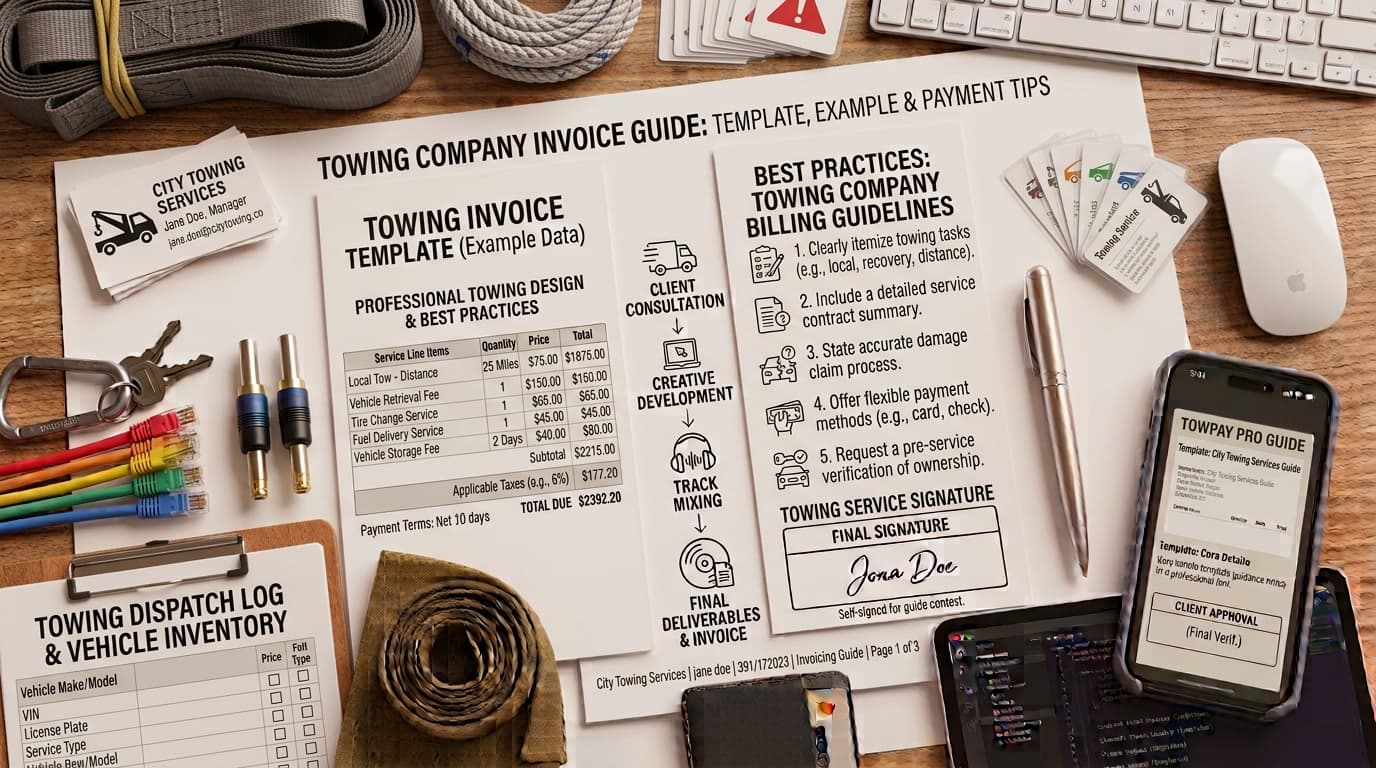
In the towing industry, an invoice serves as a primary business record for services rendered. For business owners, a well-structured invoice provides a clear summary of the work performed, which can assist in communicating service details to clients and insurance providers. By maintaining a professional standard in your documentation, you can provide clarity regarding the services provided and the associated costs.
Why a Professional Towing Invoice Matters
Many operators view their invoices as simple receipts. While a receipt confirms that a transaction has occurred, a towing invoice acts as a formal billing statement that outlines the specific terms of a service.
When you provide an itemized and clear document, you help the client understand the scope of the work. Furthermore, if a question arises regarding a service, insurance adjusters often look for a detailed paper trail to understand the costs involved. Providing a professional breakdown of your services helps ensure that you are communicating the labor, equipment, and time invested in every call.
Common Components of a Towing Invoice
To ensure your documentation is clear and useful, your paperwork may include specific data points. While the format you choose depends on your business needs, many operators include the following:
Business Identification: Your company name, address, and contact information.
Client and Vehicle Data: The name and contact information of the person who requested the tow, along with vehicle details such as the year, make, model, color, VIN, and license plate number.
Service Specifics: The date and time of the request, the pickup location, the destination address, and a description of the service, such as a mechanical breakdown or vehicle recovery.
Authorization: A space for a signature from the customer or the authorizing official, which can help confirm that the service was requested.
How to Itemize Your Towing Charges
Transparency is a practical tool for managing client expectations. Instead of providing a single total, breaking your fees into logical categories can help the client understand the components of the bill.
Example Calculation for a Light-Duty Tow
Consider a scenario involving a 10-mile, light-duty tow. A clear breakdown might look like this:
Hook-up Fee: $125 (This covers the base cost of dispatching the truck and the initial connection).
Mileage: 10 miles at $5 per mile = $50.
Subtotal: $175.
Applicable Taxes or Fees: Calculated based on your specific business requirements and local guidelines.
If the job required specialized services, these can be listed as separate line items. For instance, winching, the use of dollies, or flatbed equipment can be clearly labeled. Similarly, if you are billing for storage or after-hours gate access, these can be stated with the corresponding time stamps to provide context for the charges.
If you are looking to standardize this process, you can create a towing invoice using our digital tool to generate a clean, professional document. This tool allows you to format, preview, print, or download an invoice as a PDF. It supports business and client details, line items, payment instructions, and calculations for subtotals and totals.
Streamlining Your Billing Process
Manual billing can be a significant drain on resources. Handwritten invoices are prone to calculation errors and lost paperwork, which can delay your administrative workflow. By shifting to a digital workflow, you can standardize your descriptions, calculate totals automatically, and store records in a way that is easily searchable. Digital tools also allow you to include your company branding, which reinforces your professional reputation and makes your business look more established to commercial clients.
The Importance of Digital Record Keeping
Beyond simple billing, digital record keeping provides a organized audit trail. Having a centralized database of past invoices allows you to retrieve documents efficiently. This is particularly helpful when dealing with high-volume accounts or complex insurance claims that require proof of service. Furthermore, digital systems often integrate with accounting software, allowing you to track your accounts receivable. This visibility helps you identify unpaid invoices, allowing for prompt follow-up and improved cash flow management.
Navigating State and Local Regulations
The towing industry is governed by a variety of state and municipal regulations. Because rules regarding maximum rates, storage fees, and documentation requirements vary significantly from one jurisdiction to another, you should verify the specific rules in your area.
This is particularly important for nonconsensual tows. When a vehicle is towed without the owner's consent, local authorities often impose guidelines on how you must document the service and what fees you are permitted to charge. Always consult with your local Department of Public Safety or relevant regulatory board to ensure your billing practices align with local law.
Best Practices for Handling Disputes
Even with a detailed invoice, questions can occur. When a customer asks about a charge, your first step should be to review the signed authorization form and the itemized list of services. Often, a clear explanation of the equipment used or the distance traveled is enough to resolve the issue. If the dispute persists, having photographic evidence of the vehicle's condition at the time of pickup can be helpful. Always maintain a professional tone during these interactions, as your reputation is a valuable asset in the towing industry.
Frequently Asked Questions
Are there federal laws that dictate how much I can charge for a tow?Towing rates are generally regulated by state and local authorities, and they vary significantly based on your specific location.
What is the difference between a consensual and nonconsensual tow invoice?A consensual tow is requested by the vehicle owner. A nonconsensual tow is initiated by law enforcement or private property owners. Nonconsensual tows are often subject to higher levels of regulatory scrutiny, requiring rigorous itemization and documentation.
How do I handle a customer who disputes my invoice?The best way to handle a dispute is to prevent it with a clear paper trail. Maintain signed authorization forms, detailed itemized invoices, and photos of the vehicle condition at the scene. This evidence is your strongest asset if a customer or insurance company asks for clarification regarding your fees.
Why should I use a digital template instead of a paper one?Digital templates ensure consistency, reduce human error in calculations, and provide a professional appearance that builds trust with clients. They also make it easier to store and retrieve records for future reference.
What features does the ToolNimbly invoice generator offer?The tool allows you to create a conventional invoice that can be printed or downloaded as a PDF. It supports business and client details, invoice numbers, issue and due dates, currency, line items, payment instructions, terms, notes, discounts, and tax or fee calculations. It uses exact decimal arithmetic to calculate totals and allows you to add a logo, which is processed locally. It requires no signup and stores no data on a server.
Disclaimer: This article is for informational purposes only and does not constitute legal, tax, or financial advice. Regulations regarding towing fees and documentation vary significantly by jurisdiction. Please consult with local authorities or a qualified professional regarding the laws applicable to your specific business.
Put this into practice
Use the Invoice tool for the calculation, then read What an invoice needs to contain for the supporting explanation.